I tested Insta360’s new DJI Pocket challenger and the Luna Ultra feels more like a camera than a gimbal
Leica lenses, a 1-inch sensor and 12x zoom give Insta360’s latest pocket camera a distinctly photographic feel


Action cam innovation has plateaued slightly in the last couple of years, at least when it comes to traditional GoPro-style models. There is a physical limit to how small optics/components can get, and higher resolutions and frame rates will only get people so excited.
The new battleground, seemingly, is vlogging camera gimbals. DJI had immense success with its Osmo Pocket series, so much so that it became the number one action camera brand in Japan in 2025. It was only a matter of time until other brands decided they wanted a slice of that pie.
And while there are quite a few companies trying to launch their own take on the concept, the one rival everyone's been waiting for is Insta360. The 360º camera expert has teased its upcoming Osmo Pocket rival for quite a while, but now, it's finally here.

The waiting game is over
In fact, they are here: the Luna Series includes two cameras, the Luna Pro, which is the direct competitor of the DJI Osmo Pocket 4, and the Luna Ultra, the flagship model with two Leica Summicron lenses, 8K Dolby Vision capability, Triple AI Chip, and, supposedly, exceptional low-light performance.
I've been sent the latter, and have been playing around with it for a few days. As is always the case with products that are supplied before launch, take everything I say below with a pinch of salt. Software is often not final, and a lot of niggles can be ironed out before the camera officially lands in people's hands.

Less than a week with such a complex gadget as the Luna Ultra won't get you too far in terms of learning its ins and outs, but you can certainly get a feel of the product.
One thing I noticed immediately as I lifted the gimbal out of its box is just how substantial it feels. At 233g, it's hardly heavy, but it's more than 20% heavier than the Osmo Pocket 4. It's also taller and wider with a larger camera unit.
Zooming in on the specs
The latter is understandable, considering there are two lenses on the Luna Ultra. The dual Leica Summicron lenses offer up to 12x zoom and 6x lossless zoom. There are also 2x and 3x zoom options, which I assume are cropped versions of the second, 6x zoom lens.

The Luna Ultra uses a 1-inch sensor, which is quite large for such a small camera. This allows for more details to be captured and also better low-light performance. The camera's "triple AI chip" setup, which includes a 4nm chip and dual imaging chips, is said to work well in low-light scenarios.
Like the Insta360 X5, the Luna Ultra uses a triple-chip architecture, but swaps the X5's 5nm AI processor for a newer 4nm AI chip alongside dual imaging processors. To take low-light performance even further, the Luna Ultra also has the 4K60fps PureVideo mode, a dedicated setting to enhance clarity in low-light situations.
The removable wildcard
Back to the physical specs of the camera, the Luna Ultra has an “industry-first” detachable controller that lets you use the panel as a remote control. I’m not 100% sure it’s necessary to have on a camera with gesture control; how often would you need to control the gadget remotely?

Maybe there is a burning need for a controller, and I’m just not using the gimbal to its full potential. My only concern is that the detachable controller is a moving part and, by default, more prone to damage.
The gimbal head is already a liability, and the panel doesn’t help. The spring or plastic buttons that hold the controller in place can break, and it’s also more likely that you’ll lose the panel somewhere, rendering your Luna Ultra unusable.

The controls are also more laggy when the panel is detached, especially if you’re playing around with the zoom. This could be down to my using an early software version, but if you think about it, the remote is a sliver of a device, so it will have limited space for transmission components. There will be compromises.
A different way of doing things
On that note, Insta360 came up with a solution, not just to protect the remote but the gadget as a whole. The case is quite basic and makes the Luna Ultra bulkier, but it certainly does a decent job in making you feel less concerned about chucking the gimbal in your bag. Plus, it has accessory slots, such as for the wide-angle lens, that attach magnetically. Sweet.


The button layout on the Luna Ultra is slightly different from that of the Osmo Pocket 4. In addition to the joystick and record button, Insta360 included a zoom slider at the lower end of the handle. The two customisable buttons are located at the bottom of the rotating display, a better solution than DJI’s, which hides them under the display in vertical mode.
The proof is in the footage
As for camera performance, I only scratched the surface so far. The Luna Ultra can shoot 8K video at up to 30 fps and 4K slow-motion video at up to 120 fps, while the low-light PureVideo mode is 4K@60fps. In addition to high-resolution videos, the Luna Ultra handles colours well and can shoot in Dolby Vision.
Dolby Vision is a high-dynamic-range (HDR) imaging technology that is said to enable “dynamic optimisation for every scene, or even every individual frame.” One of the main benefits of the technology is that it’s used by other companies and apps, enabling a more seamless post-production process.


One very cool thing about the Luna Ultra’s zoom capabilities is that it can do macro photos. The minimum focusing distance is 15 cm (~5.9 inches), but with the 12x zoom (equivalent of a 240mm telephoto lens!), you’ll get plenty close to your subject. 12x zoom isn’t lossless, but the camera retains a significant amount of detail.


I’m yet to try the camera for portrait photography, but given the close focusing distance, I expect it to perform well. Photos are good; not as sharp as a DSLR or a mirrorless, of course, but the camera unit is a lot smaller, so what do you expect? At least it’s stabilised – the Luna Ultra has 3-axis mechanical stabilisation and EIS (Electronic Image Stabilisation).
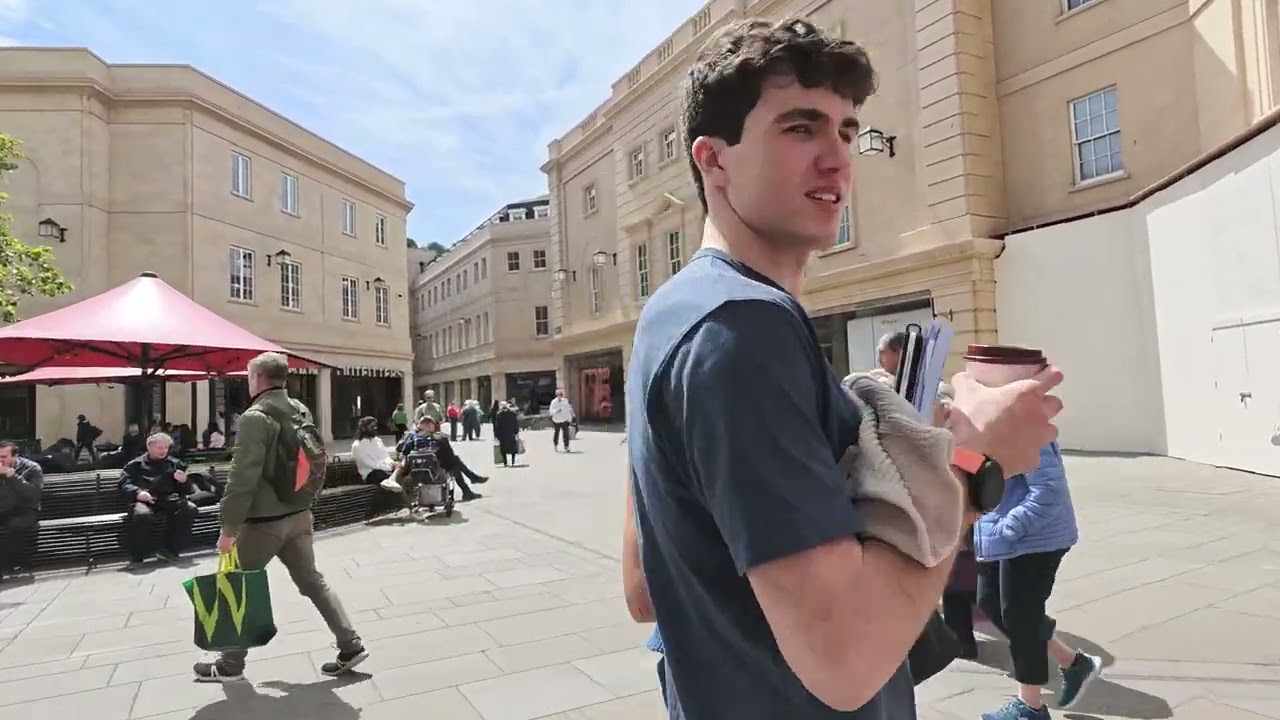
Videos look balanced and maybe a hair slightly over-exposed. I usually crank down the EV compensation to -0.3, and in this case, I went with -0.7, and the footage still looked quite bright. It was a very sunny day, mind. Have to experiment more with the different modes.
The Luna Ultra has a 1,550mAh battery and a quoted maximum battery life of 4 hours. It also supports PD fast charging, taking your camera to 80% in just 23 minutes. The camera comes with 47 GB of built-in storage and has an SD card slot, too, in case you want more.
A promising first encounter
The Luna Ultra is an interesting proposition from Insta360, and a gadget that holds enough secrets to make me want to spend time with it. I haven’t even talked about the Mic Pro, included in the Creator Kit bundle I was sent, with its unique e-ink display and unclippable 32-bit float. So much to unpack!

Insta360 Mic Pro
Is the Luna Ultra better than the Osmo Pocket 4? Well, the true comparison would be between the Luna Ultra and the Pocket 4 Pro, but I haven’t got my hands on the latter yet, so I can’t comment on it. The zoom capability and the large sensor certainly open up many creative possibilities.
Interestingly, it feels like the camera is geared more towards photography than videos. That might be a push, but the Luna Ultra has a ton of photo features, including 2:1 and 360º panoramas, macro and portrait photo settings, etc. I’m very excited to see how well the camera performs in that department.

I would also love to see how well the videos pan out, especially in low-light conditions. Historically, Insta360’s algorithm pushed colour too far if there wasn’t enough light; I wonder if the Luna Ultra performs better. The new ship setup suggests the company is trying a different approach here.
The Luna Ultra will officially launch on 18 June, which is when you can expect the full review of the camera. Plenty of testing to do before then! And on this occasion, I actually look forward to it. Head over to Insta360 for more information.
