Fujifilm X-Pro1 review
The Fuji X-Pro1 brings interchangable lenses and retro style
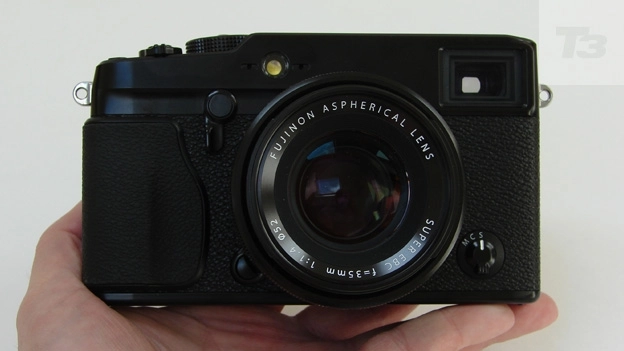

-
+
Rock-solid build quality
-
+
Full manual controls
-
+
Hybrid viewfinder
-
-
Expensive
-
-
LCD not angle adjustable
-
-
Slow auto focus on video
Why you can trust T3 Our expert reviewers spend hours testing and comparing products and services so you can choose the best for you. Find out more about how we test.



The Fuji X-Pro1 is the brand's first-ever interchangeable lens compact camera. It boldly claims to feature a sensor that's equivalent to those found in professional DSLRs...
The Fuji X-Pro1 is the brand's much anticipated 16.3 megapixel offering in the rapidly growing interchangeable lens compact system cameras (CSC's) world. Little wonder then that Fuji has belatedly joined a sector that already boasts strong offerings from Olympus, Panasonic, Nikon, Pentax, and Sony, with Canon strongly rumoured to be throwing its own hat into the ring.
Like the manufacturer's fixed lens 'X' predecessors in the Fuji X10, Fuji X100 and Fuji X-S1, the new Fujifilm X-Pro1 has a very cool retro look, drawing inspiration from enthusiast and professional's favourite Leica; not only in the design, but also in the handling and control layout.
This then is not your average happy snapper. Its impression of luxury is confirmed when you heft the heavyweight metal-build compact from the box and attach one of its X-mount system lenses. There are already three available despite the camera's newness.
Of course, no matter how sexy the camera appears, and ready to withstand a war it feels when held, picture quality is what we're after. Noteworthy in that regard is Fuji's claim for its newly incorporated 'X-Trans' APS-C sized CMOS sensor.
Though the physical dimensions of this chip are comparable with those found in entry and mid level digital SLRs – a quality also boasted by the excellent Sony NEX-7 – Fuji says that when coupled with its new EXR Pro processor results are actually on a par with cameras sporting a full-sized sensor: namely pro models costing several thousands of pounds.

Unsurprisingly then the Fuji X-Pro 1 retails for a sizeable £1399 itself, and that's body-only.
Fujifilm X-Pro1: Controls
As with its fellow X series compacts, the X-Pro1 offers a Leica M8 rangefinder-like control layout, including chunky dials for adjusting exposure compensation (+/- 2EV) and manually controlling shutter speed from 1/4 sec to 1/4000 sec.
The alternative is of course to leave it on auto and simply point and shoot, but that isn't really where the camera's pitched. The X-Pro1 will appeal to those who like having control at their fingertips and to influence the outcome of a shot.
The solid bulk of the camera, with aluminium alloy top and base plates, plus small rubber grip to the right hand side, does however provide a reassuringly steady hold for handheld shooting. Three interchangeable prime (non zoom) lenses are available on launch, and were supplied with our review sample: a wide-angle 18mm, a 35mm for general-purpose photography and a 60mm macro (close up) lens.
All of these are easy to attach and remove via a springy lens release button to the bottom of the new X-mount. This is a great camera for shooting from the hip, and is particularly suited to street photography.
Fujifilm X-Pro1: Screen
The Fuji X-Pro1 comes with a choice of how you compose images. It offers both a regular 3-inch, 4:3 aspect ratio LCD screen on the backplate as we'd expect, plus a smaller 0.47-inch 'hybrid' viewfinder top left, which will really appeal to photo enthusiasts.
Unusually, this viewfinder can be used as an optical viewfinder – in other words you can see through it to frame up a shot whether the camera is switched on it not. But also, with the camera activated, the same viewfinder provides an electronic overlay of key shooting info and focus points.
Facilitating use, an eye sensor alongside it automatically switches the electronic viewfinder (EVF) on, and the larger LCD screen below it off. Alternatively there's a 'view mode' button if you prefer to control this option manually.
An added beauty of the viewfinder being electronic as well as optical means that pictures just taken can be reviewed without having to take your eye away from it and alternatively check on the larger screen below.
Furthermore both the EVF and the fixed, non-angle adjustable LCD monitor boast very high resolutions indeed, providing crystal clear viewing. The former offers a top of the range 1,440,000 dots, while exceeding the specification of most digital SLRs the bigger screen has 1,230,000 dots.
Though the choice of being able to tilt and swivel the LCD might have been a nice extra here, and creative low or high angle shots are slightly tricky as a result, it's not a deal breaker and this aside the X-Pro1's options are hard to fault.
Fujifilm X-Pro1: Battery
The Fujifilm X-Pro1 comes packing a NP-W126 lithium ion rechargeable battery, inserted into the base of its handgrip. The battery compartment is shared with a slot for all variants of removable SD card media card (SD, SDHC, SDXC). There's no internal memory to fall back on.
The 300 shot battery life is average rather than class leading, and falls just below the 335 shot battery duration of the Sony NEX-7 and the 330 of the Olympus OM-D E-M5 camera, both of which are a very close match for the X-Pro1's target market and are £999 body only. In practice this meant we were recharging the Fuji's battery after a couple of days' fairly solid use.
Fujifilm X-Pro1: Image quality
For general-purpose photography we were using the X-Pro1 with the 35mm lens attached. Coupled with the APS-C sized sensor this is capable of delivering bags of detail across the frame for general scenes and some lovely shallow depth of field effects – subject sharp but background attractively blurred – when shooting closer up to a subject.
There's no doubt both camera and lens are of a high quality, and for many DSLR users this camera could provide a decent back up, although we'd hesitate to declare it a complete replacement, as, if relying on auto focus it's a little slower than we might expect given the price.
However, the smaller size, while it won't fit in a pocket, means that we were opting to take it out more often than our DSLR for near professional results. Colours are lovely too, and naturalistic with it – perfect for picking out spring blooms in fact – and here 16.3 effective megapixels doesn't overload the sensor and introduce intrusive noise in the shadows.
The camera prompts experimentalism and a period of familiarisation however, so be prepared to try a few attempts to get the shot exactly as you want it.
Stills aside, there is additionally the option for video clips, here offered at a maximum Full HD 1920x1080 pixels and a respectable rate of 24fps rather than 30fps to a maximum 29 minutes duration.
Sound is also stereo, courtesy of two pin-prick microphones located at the front. There's no dedicated video record button for instant filming however, which would have been handy. Instead the user needs to press the drive mode button and tab down to the video option, at which stage the screen display narrows to provide a 16:9 ratio format.
Video recording then commences by pressing the shutter button to start, with a subsequent press ending the clip. Though the camera will automatically adjust focus for you, we found it a little slow to catch up if we altered framing. Certainly this doesn't seem as especially geared up to video as the likes of Sony's NEX-7, but the capability is there.
Fujifilm X-Pro1: Verdict
With its rangefinder-like dials and knobs up top, plus DSLR-style controls at the back, the 16.3 megapixel Fuji X-Pro1 is every inch the enthusiast's camera. It encourages experimentation rather than just pointing and shooting, plus, with its buttons and dials, a period of familiarisation will be required even by those used to shooting with either premium fixed lens compacts or digital SLRs.
Though the metal build quality and feature implementation is extremely high, so too is the body-only price at £1399; this makes the Sony NEX-7 and Olympus OM-D, sizeable investments on their own, suddenly appear budget alternatives.
But if you've ever longed for a pro-level snapper, can stump up the cash and are prepared to invest in yet another new system, this camera is likely to be the only one you'll need. That's if you are actively seeking a tool that is (mostly) good enough to enable you to leave that even bulkier digital SLR at home. And it looks incredible too.
Fujifilm X-Pro1 availability: Available now
Fujifilm X-Pro1 price: £1399 (body only)
