75 years of Fender Telecaster – an all-star country line-up, a mega jam, and one legendary guitar
The Fender Telecaster has some of the world’s biggest artists as fans, but what has made the guitar such a success? And can it survive in a world of AI?


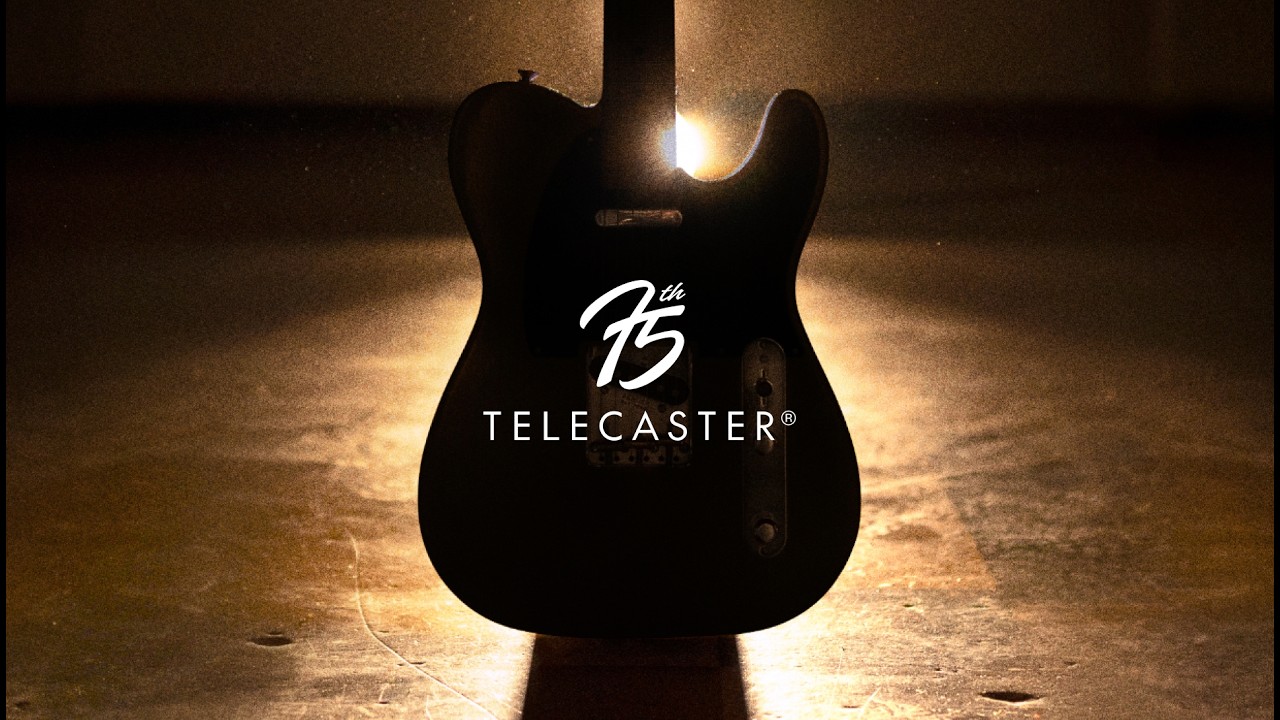
A guitar that changed it all. 75 years ago, the Telecaster rewrote the rules, and it remains one of the most popular instruments to this day.
A one-night-only performance is taking place at the Ryman Auditorium in Nashville, the spiritual home of country music that has hosted the Grand Ole Opry and just about every important artist in the last 125 years.
On the stage are legends in the world of country music, from Brad Paisley to Brent Mason, as well as musical superstars from ZZ Top’s Billy Gibbons to Elvis’ guitarist James Burton and even Jack White. This kind of gathering is normally reserved as a tribute to a legendary act's passing, but tonight it's to celebrate the 75th birthday of a different kind of legend – the Fender Telecaster guitar.
Launched in 1951, this was the first mass-produced solid-body guitar. It’s a simple design with a clean and clear tone that has proved popular across all genres of music, from country to rock, pop and punk. So what has made it so popular with musicians and guitar fans?
Having grown up on rock and indie, I’ve always loved the simplicity of the Telecaster compared to the likes of the Stratocaster and the Gibson SG. It’s the Bauhaus design to the Art Deco, but with so much customisation, two models can barely look like the same guitar.
Fender's concert was named Tele Town, as almost every country artist in Nashville seems to play a Tele. After seeing the acts playing in those Broadway bars each night for myself, that’s no exaggeration.

The Fender Telecaster
So why has the Telecaster been so successful over the last 75 years? Leo Fender’s invention was designed to solve a problem. At the time, bands were playing live more and looking for more volume, while trying to figure out feedback. Leo’s answer was a solid-body electric guitar that was modular in construction and could be mass-produced.
“Everything that followed came up through the Telecaster; the Stratocaster, the Jazzmaster, the Jaguar. Everything we've done was on the basis of what Leo did, says Fender CEO, Edward ‘Bud’ Cole. “The guy was an engineer. He didn't play guitar. He listened to what musicians wanted. He got so incredibly focused on that. And that guitar is everything that it needed to be in its perfect form and nothing more.”
It took discipline for Leo to not add more to the Telecaster, but he kept the design incredibly clean. There is not a single embellishment or additive on the first Telecaster guitars that were made. That was part of their charm.
“The guitar is simply a white canvas for anyone who picks it up,” says Cole. “Whether you are an R&B player, a blues player, a country player, a rocker or a hard rocker. Whatever kind of music you want to make. That is the basis for making it, and it's so versatile. The tonality is so pure and flexible. And reliable, so that whatever you can hear in your head and your heart as an artist or a player, you can articulate on a Fender Telecaster.”

Nashville: Music City
While Fender’s main base remains in Southern California, it opened a Nashville hub back in 2024 to be closer to its local artists. The space includes a private showroom, meeting rooms, a gig space and a full workshop, where custom models can be built and adapted for artists. It’s an intentionally private space where artists can come with discretion. There’s no sign on the door, it’s not even listed on Google Maps.
“Nashville is a very creative community. A lot of artists live here, which is why we picked here,” says Tim Shaw, Fender’s Chief Engineer here in Nashville. “Everything we do here is designed for manufacture, or if an artist wants something that’s really idiosyncratic.”
Jack White’s Triplecaster design started in this facility, and he spent close to a year and a half developing different models with the Fender team here. This resulted not only in the guitars he plays on tour but also in the signature collection that is now available to buy.
“These artists make their living through the tools that we give them,” says Cole. “It's the air they breathe. And so, it's incumbent on us to A, make the products and B, give them forums to try new instruments, to try new fabrications and new technology to unleash that creativity.”

The Ryman Auditorium
Built 130 years ago, The Ryman is the heart of the country music scene. Originally named the Union Gospel Tabernacle, it took on the name of the man who built it (Thomas Ryan) in 1904, after his death.
The space is best known for hosting the Grand Ole Opry for nearly 31 years and has seen some of the world’s biggest acts play on its stage. From Elvis and Johnny Cash, to Foo Fighters, Lizzo and Taylor Swift, there’s barely an artist who hasn’t been on this intimate stage.
With seating on two levels, stacked right up to the stage, the venue feels deeply intimate. Touring the theatre earlier in the day while empty gave me goosebumps, but when full of people, it’s electric, and the acoustics are second to none.

Larkin Poe with ZZ Top's Billy Gibbons
The combination of its history and importance in country music made The Ryman the perfect venue for Fender’s Telecaster celebration, and so a one-night event was conceived.
“Supporting the players and the artists is really our mission,” says Cole. “Last year, we did what was called the Fender Experience in Tokyo. It was three days, 45,000 people came to it, 27 shows, 27 acts. A lot of education about our products, but a lot of live performances. And so, the next execution was Tele Town right here, specifically for the Fender Telecaster and the launch, because of our history in Nashville.”
With so many great artists in Nashville devoted to their Telecasters, deciding who not to invite was probably trickier than who to put on the lineup. The result was a balanced roster, including country music legends, session artists, local stars and a selection of new and emerging guitarists.

Jack White
Some surprise guests to take the stage included Billy Gibbons, the founding member of ZZ Top and indie legend Jack White. To end the evening, country legend Brad Paisley presented Elvis’ guitarist James Burton with a replica of his 1967 “Lost Paisley” Telecaster, while Zac Childs showed off Burton’s restored Tele that he played from 1952 to 1969.
The evening finished with what has to be one of the most impressive country jam sessions in history, as the majority of the evening’s artists played together on stage.
“We've all seen a lot of great stuff, but to see the electricity and the great momentum that was happening from the beginning of the show throughout the show, you really started to feel like something is elevated,” says Cole. “That is the most fun I've had on stage ever, and to see the diversity of the players, and the acts, and just the dynamism of how we went through that set list. And of course, James Burton coming out. I think everybody felt that night was very special.”

Fender 75th Anniversary Player II Telecaster in diamond dust sparkle
75th anniversary guitars
To commemorate this significant milestone for the brand, Fender also released five limited-edition Telecaster models that pay tribute to its heritage.
These include a Vintera Road Worn 1951 Tele in butterscotch blonde, an American Ultra II Tele in liquid gold, an American Professional Custom Tele in two-colour sunburst, an American Professional Classic Cabronita Telecaster (in either Ice Blue Metallic or Candy Apple Red), and my personal favourite, a Player II Telecaster in diamond dust sparkle, as played on stage by Larkin Poe’s Rebecca Lovell.
Prices range from £949 ($1099) for the Player II, up to £2,899 ($2999) for the American Ultra II. There’s also a Telecaster T-shirt, a 500-piece jigsaw and a coffee table book, all available on the Fender website.

American Ultra II Tele in liquid gold
A global offering
Cole took over the role of Fender CEO earlier this year and not only has a global outlook for the brand, but is ready to embrace new technology.
“I set up Fender. Music Corporation Japan, APAC, in the basement of my house,” says Cole. During his 10 years in Asia, he launched Fender’s first flagship store in Japan, as well as building the business in Australia, China and Korea.
Asia has long been an untapped market for guitar brands, and Fender saw the potential. “If you can imagine where the United States or Europe was in the nineteen forties and fifties with Rock and Roll just about to start to blossom,” says Cole. “When you go to China, Vietnam or Indonesia and you hear the music that they're creating, what they're doing with guitars – it's profound.
“The first 80 years of Fender's Growth and expansion have been all about taking American culture out to the rest of the world,” says Cole. “The next 80 years will be about Fender reaching out to the rest of the world and taking in their unique interpretations of what can be done on a Fender guitar and reabsorbing them back into what we do best at Fender, which is support players at every stage of their musical journey.”

Fender CEO Edward 'Bud' Cole
Moving in a digital world
While electric guitars are, by definition, electronic instruments, they’re not digital. However, Fender hasn’t shied away from digital technology. Digital amplifiers, headphone amps and digital pedals sit alongside valve and solid state models, while Fender Studio includes a full suite of software, interfaces controllers and plugins for digital recording.
“Our fundamental reason to be is that we make electric guitars, acoustic guitars, amplifiers, says Cole. “Everything around that is to support the player on their endeavor to play guitar and bass. So digital is an accent, and an accessory to enable the guitar player to better express themselves.”
The guitar remains the main focus for Fender, and Cole believes that no digital device can replace that. “I don't believe that in my lifetime I'm gonna see people get up on stage with something that is as intimate and effective to convey what's going on your head, musically as an electric guitar.”
But there’s still a place for digital in the ecosystem, to assist in making those sounds the artists want to create, whether that’s through pedal boards, digital loops or digital amps. “These digital products and tools are real, and they're actually very helpful for people. But they are there to help and assist the artists,” says Cole. “The guitar is the main act.”

AI in Music
Artificial intelligence (AI) is often a dirty term for creatives, but surprisingly Cole has a very open mind to it and is ready for Fender to embrace it. Like any new technology, Cole explains, there’s bound to a fear. “When the Telecaster came out, it was polarising. There were people that loved it and adapted, and some people that thought it looked like a rope from a rowboat, or it looked like a plank.”
Cole’s philosophy is that AI in music is nothing new. “I think AI has existed in music as long as there's been recorded music,” he says. While the biggest barrier to playing guitar is the time it takes to learn the instrument, it’s the second barrier, writing songs, where he believes AI plays a part.
“I actually believe cover music has been sort of analog AI for a long time,” says Cole. Those that don’t yet have the skills to write their own songs can play the songs written by their favourite artists instead. “I listened a lot to REM, U2, The Smiths and The Cure, and at some point I got sick of just listening to them. I wanted to play it, so I learned to play guitar.”
Those taking their first steps into writing, according to Cole, can also lean on a second analogue form of AI: their band mates. You might just have a chorus or a riff to start with but then the drummer or bassist can add to it, and a song is born. AI can also play this role. “I actually think that we are in the brink of freeing up people to move beyond the same old covers and to really get into working like they do with their bands,” says Cole.
It’s a refreshing perspective that AI can provide that help to turn a wannabe song writer, or wannabe musician into an artist. “I think we have to be careful, but we should look at how this technology can help us,” says Cole.”I believe that AI is actually going to help create a whole new world of guitar players that use it. To help connect with other musicians, to be more productive. And across the chasm into becoming a student of songwriting to a master of songwriting. That's the hope anyway.”
