Engwe Zip review: a solid Brompton-style e-bike for cash-strapped urbanites
Engwe’s new Zip e-bike brings foldable freedom and nippy performance to a city near you


The Engwe Zip doesn’t try to reinvent the 16-inch wheeled folding e-bike, but it refines the formula very nicely indeed, and at a price that may shock most Brompton e-bike users. The Zip's weight is sensibly low (19 kg with battery), the folding process is mostly fuss-free, and the ride is amazingly stable and surprisingly comfortable. While the Shimano 7-speed gears are admittedly a mite too basic for slick shifting, they do provide a practical spread for urban riding and gentle gradients. If you're in the market for an affordable Brompton-like e-bike with all the trimmings, this one passes muster.
-
+
Stable, comfortable ride
-
+
Easy to fold
-
+
Seat post suspension
-
+
Decent battery range
-
+
7-speed gears
-
+
Multiple riding positions
-
+
Great price
-
-
Ungainly cable harness
-
-
Fiddly removable pedals
-
-
Stiff top tube folding hinge
Why you can trust T3 Our expert reviewers spend hours testing and comparing products and services so you can choose the best for you. Find out more about how we test.

Welcome to T3's review of the Brompton-esque Engwe Zip, a new style of folding electric bicycle for commuting, city touring and leisure riding that doesn't cost the earth to buy.
I'm a big fan of folding bikes of all styles, mostly because they're easier to store indoors, perfect for the average three-mile commute, great for car-based holidays, and, when folded, can be taken on trains and buses and into most commercial buildings like restaurants, offices, and shops.
Engwe is a popular budget-friendly electric bike brand known for its high-performance, fat-tyre folding e-bikes sold directly to consumers through both online and brick-and-mortar stores.
I've been riding about on the Zip for the past few weeks, and I'm very impressed by its comfort, stability and overall ride quality. It's relatively quick to fold and comes with a UK-legal 250W rear-hub motor and outboard battery that provide plenty of electric oomph on the flat and gentle inclines.
Is the new Engwe Zip an electric Brompton killer and therefore worthy of a lofty spot in T3's guide to the best electric bikes? I’m thinking it just might be.
Engwe Zip review
Price and availability
In the UK, the Engwe Zip retails at £899 and is currently available directly from Engwe, Ride + Glide, Man Firth and Med Bike. You can be sure it will also be available at Amazon in due course.
The Engwe Zip is a Euro-spec bike with a 250W motor, so you can't buy it in the USA. However, it is widely available throughout Europe, priced at around €999.
Specs at a glance

- Weight with battery: 19.4 kg (42.77 lbs)
- Max load capacity: 120 kg (264.55 lbs)
- Frame: Steel
- Tyres: 16"×1.95" Urban Hybrid
- Battery: 36V 10Ah (360Wh)
- Pedal assist: 3 levels
- Power: 250W
- Max torque: 40Nm
- Range: 37 to 74 miles (60 to 120km)
- Gears: 7 (11–28T)
- Brakes: Hydraulic disk
- Display: 3.2" colour LCD
- Charging time: Up to 6 hours
- Waterproofing: IPX5 (motor) to IPX7 (wiring)
Design and build quality

Available in two colours – olive green and grey – the new Engwe Zip is a much, much cheaper option than its most obvious folding rival, the fabulous Brompton Electric G Line.
Just to put its price into perspective, the Zip currently retails at £899, and quite a bit less (between £550 and £675) if your employer is a member of Cyclescheme.
By stark contrast, the Brompton Electric G Line costs between £3,349 and £3,700. And yet, at 19.2 kg with the battery attached, the Zip weighs roughly the same as the Electric G Line. This is an insane stat right from the off. So how have they done it?
Well, for starters, the Engwe is designed and factory-built in China, while all Brompton bikes are still hand-built in London, so that's about all you need to know.
However, it doesn't stop there because the Zip is exceedingly well kitted out from top to toe with a UK- and EU-legal 250W rear hub motor, a 36V 10Ah (360Wh) outboard battery, Shimano Tourney 7-speed derailleur with Rapid Fire shifter, front and rear Shimano hydraulic disc brakes, suspension seat post, and side stand.
It even comes with a brilliantly designed front-mounted waterproof battery bag with enough space above the battery for a rain jacket, plus a front zipped pocket for an emergency repair kit. An optional easy-to-fit rear bike rack is also available. That's a lot of onboard gear for a budget e-bike weighing under 20 kilos.
While there's no information on the alloys used in its standard steel frame, which has a max load of 120 kg, the quality of the welds is worth noting, with no signs of budget-driven workmanship or corner-cutting.
The Engwe's longish wheelbase and fat 16-inch tyres make this bike feel remarkably stable at speed and over uneven road surfaces, and that's a major plus because many small-form folders can often feel jittery and unstable when pushed to their limits. As long as the tyres are pumped to their maximum PSI, you should feel very little resistance when riding on tarmac.
One unusual feature with this bike is that it's fitted with a single front fork, and the funny thing is that you simply don't notice this even when looking closely at the bike. The obvious reason for having a mono fork is to help reduce both weight and to make folding more practical, which I will discuss in detail below.


The Zip is designed to fit all rider sizes – both male and female – and comes equipped with a telescopic suspension seat post and a handlebar stem that can be set high for a sit-up-and-peg riding position or really low for those who prefer a more racy posture. While they may not be to everyone's taste, I rather like the flat-style grips that let me ride on the flat by resting my palms on them.
From a safety point of view, the Zip also ships with a bright LED headlamp powered by the main battery, a rechargeable rear red LED that, sadly, doesn't flash, and the obligatory bell.
Any bike kitted out with an electric motor, LED display, hydraulic disc brakes and a 7-speed rear derailleur is bound to have cables galore, and these need to be hidden and protected where possible.
In this instance, the main control cables are gathered inside a neoprene harness that runs from the handlebar to the start of the top tube, where some of the cables disappear inside the frame and reappear towards the rear.
Since I prefer my bars very low, the main cable harness tends to bend outwards in an ungainly fashion. I have managed to work around this by unclipping the handlebar and twisting it around so the cable harness bends over the front of the bag instead. If you prefer riding in an upright position, you won't have this aesthetic issue because the slack in the cable is taken up by raising the handlebar stem.


Before we head to the bike's battery and drivetrain, I should add a quick shoutout to Engwe for fitting a pair of excellent Shimano hydraulic disc brakes that stop the bike on a sixpence in all weathers. These brakes have a lovely, spongy feel that doesn't snatch, and they're perfectly dialled for feathered braking when you just want to knock a little speed off down a hill.
However, I should add that my review sample came with the brake cables reversed – front brake on the left lever and the rear on the right – which is how brakes are configured in the USA, France, and many parts of Europe. In the UK, Australia and Japan, we have our brakes the other way round with the left lever controlling the rear brake, etc.
If you're used to the Euro and US braking system, you can safely leave as is, but if you're used to the UK system, then I would absolutely advise switching the cables around before you go on your first ride, or muscle memory will cause you to pull the wrong lever, and if you did this at speed, you could end up over the handlebars.
To fix this, simply pull off the sleeves where the cables attach to the levers and, without touching the levers, firmly pull the brake nipples out of the lever connectors, noting which cable is which.
Warning: do not pull on or even touch the levers when the cables are out, or hydraulic oil will spurt out of the lever's reservoir, and you will have to buy more oil and go through the rigmarole of bleeding the brakes.
Now, carefully push the back brake cable into the left lever and the front cable into the right. Refit the cable sleeves, and you're good to go.
Battery and drive systems


The Engwe Zip's 36V 10Ah (360Wh) battery is stored in a front-mounted waterproof bag that’s expandable upwards to fit a folded rain jacket, gym equipment or anything else you want to stuff in it.
For charging it via the supplied USB-C charger, up to six hours when depleted, the whole bag or just the battery can be easily removed using the provided key. You get two keys with the bike, and you should always have one of them on you whenever you’re out and about.
Also, never leave the key in the battery lock, or it could fall out while riding. Incidentally, the battery can also be used to charge most mobile devices.
To access the battery’s on/off button, there’s a small velcro flap. Don’t forget to switch the battery on first, or no electronics will function. Likewise, it’s good practice to turn off the battery when leaving the bike unattended or in storage.
Although a determined thief can steal any bike, turning the battery off when, say, popping into a local corner shop is a good anti-theft measure that would make it difficult to ride away at speed.
According to Engwe, the battery should provide enough juice to cover between 37 and 74 miles (60-120km), depending on which PAS (Power Assisted System) setting you're in and whether there are many hills.
Speaking of which, you get three levels of power assistance here, and each setting provides motor assistance at different levels of pedal input. I always go full-on and set it to PAS 3 for maximum torque and ease on the legs, but then I'm not riding excessively long distances.
The Zip uses an EU-legal 250W rear hub motor that strikes a decent balance between efficiency and everyday usability, though surely the time has come for the UK government to consider raising the power limit for e-bikes.
In the UK, Europe and Australia, motor power is capped at 250W, but in the USA, it's a whopping 750W, in Canada, 500W and in China, 400W.
In the UK, this low wattage equates to a maximum assisted speed of just 15.5 mph (25 km/h) – slower than a normal bicycle – while in the USA, it's between 20 and 28mph. Time for a change, methinks.
Producing around 40 Nm of torque, the Zip's motor delivers smooth, predictable assistance that feels particularly well-suited to urban riding and gentle inclines.
Unusually for an e-bike at this low price point, the Zip also comes with a torque sensor that measures how hard you’re pedalling, delivering instant, natural-feeling power when you most need it. It is especially practical for climbing hills and navigating varied terrain.

Many small folding e-bikes are either single- or 3-speed, but this one comes with a Shimano Tourney 7-speed drivetrain, comprising an entry-level Shimano Tourney RD-TY300 rear derailleur, a 7-speed 11–28T cassette, and a RapidFire shifter. This setup offers a useful spread of gears for city riding, gentle inclines and stop-start traffic.
However, there will be occasions when you wish for a larger front chainring, especially when zipping along on the flat or heading down an incline. Also, while shifts are generally light and predictable, there is scope for improvement by fitting a higher-quality derailleur, such as a Shimano Altus.
Like all decent e-bikes, the Zip is equipped with a handlebar-mounted colour display and three buttons: on/off, +, and -. The + and - buttons are used for selecting your preferred level of power assistance, but if you quickly tap the on/off button, it scrolls through four main parameters: Odometer, Trip Odometer, Maximum Speed and Average Speed. To turn on the headlight, press the + button for two seconds.
The Zip can also be used in tandem with the Engwe app, which is a bit low on features, though it at least lets you record your ride's statistics and show them on a map. To make the most of this feature, you need to mount your phone on the handlebars.
Folding mechanism


No folding bike of any style comes even close to the copyrighted folding mechanism of the Brompton, but Engwe's made a very decent fist of this one. The Zip uses a three-fold system and a single-sided front fork that helps collapse the bike in about 30 seconds – the Brompton takes about 15 seconds and requires far less effort.
In practice, the Zip's process is mostly straightforward and involves unlatching a clip near the bottom of the seat post and pulling up on the frame to bring the rear wheel forward (there's a handy grab handle for this). This reduces the overall length of the bike.
Stage two requires releasing the main latch on the top tube and folding the frame inward, and stage three involves collapsing the handlebars. Bizarrely, I'd say that the Zip's folded package is actually smaller than the Brompton when folded, and that's well worth a round of applause.
When fully folded, the Zip can be wheeled along on its two small satellite coasters, as long as the handlebars are still in the up position. No, it’s not a patch on the Brompton, which uses two satellite wheels and another tiny wheel fitted to the rear mudguard for silky-smooth pushing along a platform or concourse, but hey, the fact that the Zip has this mobility option at all is cause for a little celebration.
Performance and ride quality
I've been exceedingly impressed by how well this bike rides. It's surprisingly stable and safe feeling given the small 16" wheel dimensions and, thanks to the fatter tyres, suspension seat post and plush saddle, it's amazingly comfortable, too.
In fact, I was blown away by how well it soaked up the lumps and bumps of the UK's gnarly roads without jumping about or veering off track.
I also love this e-bike's multitude of handlebar and seatpost height configurations that allow me to use the saddle up high and the handlebars low down for a racing bike-style position when riding at speed, or, for gentle flat city riding, have the handlebars set high for the classic sit-up-and-beg riding posture.
If I were to nitpick, I would prefer a little more torque sensitivity on the move, because as it stands, a little too much muscle effort is required to fully engage it. But on the plus side, the torque kicks in immediately when setting off – and that's a boon for pulling away from traffic at the lights and when performing a hill start.
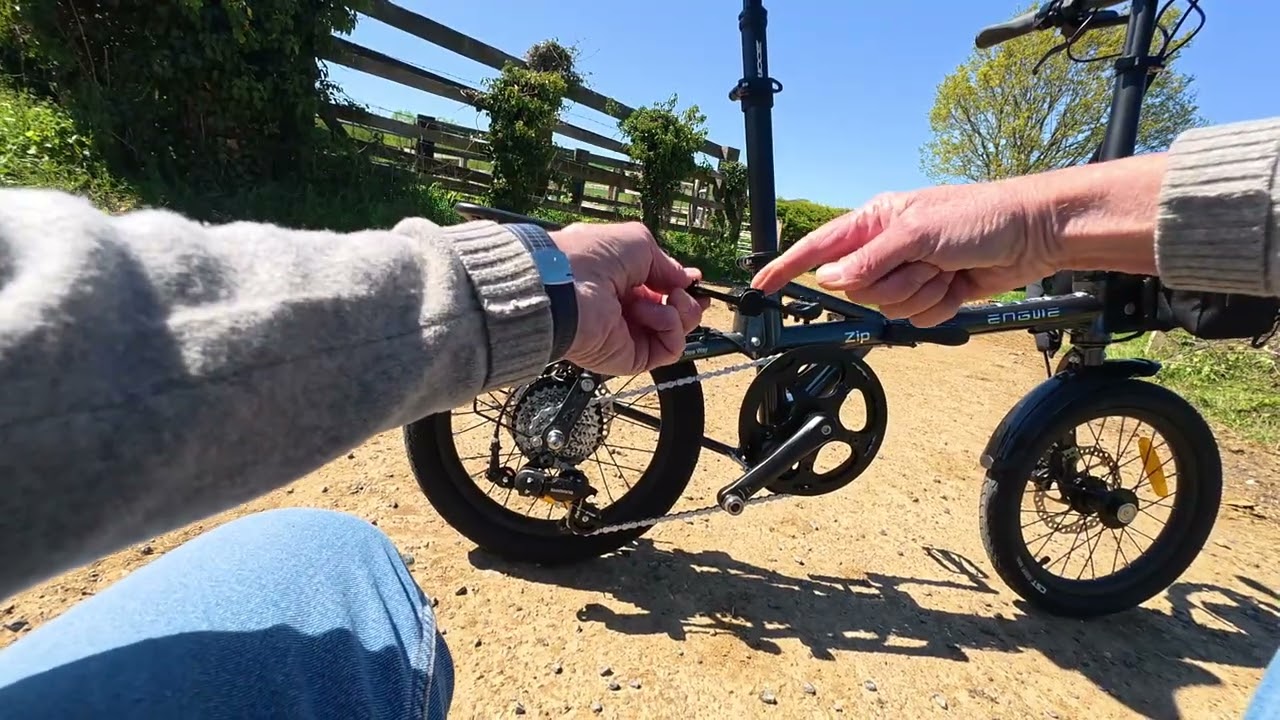
Likewise, I might consider replacing the 7-speed Shimano Tourney derailleur with a better model, because this one is difficult to find the sweet spot on the barrel adjuster when changing through the gears – one minute it’s not shifting to seventh, the next it’s not shifting to first.
This is a common issue with cheaper derailleurs and something that is easily solved by spending a little extra for super-smooth shifting with fewer hiccups.


While I like the idea of Zip's removable, slim-profile pedals – there's a storage place for them on the frame when fully folded – the centre barrel does protrude above the pedal cage, and you can feel it when wearing soft-soled shoes like Converse trainers.
Also, I’m not keen on the fiddly spring-style pedal fitting system, which is frustrating when you just want to quickly clip them in and go.
Verdict

The Engwe Zip is a well-rounded and cleverly designed folding e-bike that prioritises practicality over outright speed. At around 19kg with battery, it’s relatively manageable to lift and carry, while the ride quality is impressively composed for such a compact 16-inch wheeled machine.
Its folding mechanism, too, is relatively quick and intuitive, making it genuinely useful for daily commuting, while its low-spec Shimano 7-speed gears provide a sensible range for city riding, even though they're not the sharpest of shifters.
