This retro games console is capable of playing AAA PC games alongside the classics – looks like an NES but runs like a Ferrari
The AceMagic Retro X5 mini PC has the looks as well as the hardware for gaming through the ages


Quick Summary
It looks like an NES but plays like a PC. The AceMagic Retro X5 is arguably the best-looking mini PC on the market today.
It's also one of the most powerful, too.
AceMagic has carved a name for itself in the world of Mini PCs and laptops – thanks to a portfolio that spans affordable gaming laptops and premium mini towers. But its the AceMagic Retro X5 that most caught my eye when it was first announced earlier this year.
As the name suggests, its design pays homage to 1985 and, most notably, the Nintendo Entertainment System. However, it also just happens to be one of the most capable mini PCs on the market today.
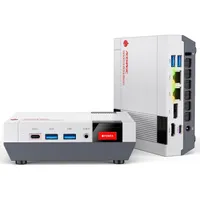
The case couldn't be more old school Nintendo if it tried – right down to the two-tone grey plastic case and black strip on the side. It even has a similar ribbed effect in that side zone, albeit running up and down the top rather than horizontally.
Design and specs
There are also many more connections and ports, of course, with a single USB-C on the front and two USB-A, plus a 3.5mm audio input for headphones or mic. It's rounded off with a bright red power button, which wasn't on the original NES but still seems fitting.

On the rear you get two additional USB-A ports, another USB-C, two 2.5-gigabit LAN ports, a HDMI 2.1 output, a DisplayPort 2.0, and a power input. There's also Wi-Fi 7 and Bluetooth 5.4 on board, so it's a bit of a step-up in comparison with its inspiration.

It's also worth noting that one of the USB-C ports is USB4, so can support 4K 60Hz video out and up to 40Gbps data speeds. The other is USB3.2, so still capable of 4K 60Hz video but with a maximum of 10Gbps data transfer.
Inside the Retro X5 you'll find the AMD Ryzen AI 9 HX 370 chip, with 12 cores and 24 threads. This is coupled with AMD Radeon 890M integrated graphics, so among the best found in mini PCs today, but not primarily designed for AAA gaming.

That's not to say it can't play some of the best PC games around today, but do be prepared for lower resolutions (around 1080p is the sweet spot) and graphics settings.
I'll come to that in a bit, but basically the fact that this looks like an NES but does surprisingly well with many modern games makes it a super all-rounder. And if you're looking for a cool-looking desktop PC that also saves space and can munch through AI image generation and video editing, well you can't go far wrong there either.
The stock model comes with a 1TB M.2 2280 NVMe SSD and there's a slot for another – with a maximum of 4TB allowed across them. There's 32GB of DDR5 RAM (5600MHz) installed across two 16GB cards, and you can also upgrade those up to a total of 128GB (if and when RAM finally drops in price again).
This all makes for a speedy, fast-booting experience regardless of its use. The HX 370 chip is designed with AI operations in mind, so that's a boost, but I'll be honest, from first glance, this just wanted to be used for gaming – retro and otherwise.
Software support – Windows or something else?
I went through a whole lot of options during my test, including gaming through the Windows 11 Pro build it comes shipped with, to dual booting into Bazzite and ChimeraOS on separate SSD installations. Performance was better in Windows, to be honest, but the console-like SteamOS experience both of the others offer was more tempting.
I also tested the AceMagic Retro X5 with the latest version Batocera and if retro gaming is all you plan to use it for, this is a superb option as it's the fastest, most complete retro front-end available today. However, it seemed a waste with so much power under the hood.
While still using Windows, I ran some 3DMark tests to see how the mini PC performed and the results were similar to other HX 370 models – which don't usually come in such pretty clothing.
Having switched the PC into "Performance" mode in bios and dedicated 8GB to the GPU, I also then used AMD Software: Adrenaline Edition to boost that further to 12GB (it's not an option in the bios itself). The results therefore reflected that.
Test |
Score |
GPU |
CPU |
|---|---|---|---|
Time Spy |
3,640 |
3,254 |
11,163 |
Time Spy Extreme |
1,946 |
N/A |
N/A |
Steel Nomad Light |
3,126 |
N/A |
N/A |
Steel Nomad |
535 |
N/A |
N/A |
Solar Bay |
16,041 |
N/A |
N/A |
Solar Bay Extreme |
1,946 |
N/A |
N/A |
I also ran a Cinebench GPU test which gave me a score of 5,728. In comparison, while an M2 MacBook comes out higher, it's not by much.
Gaming performance
The upshot of all this becomes apparent while gaming. Older AAA titles, like Rise of the Tomb Raider and Batman: Arkham Origins run in up to 60 frames-per-second at 1080p and with medium settings.

You can even massage the likes of Cyberpunk 2077 and Dead Island 2 to run at 40fps or higher, albeit without ray tracing switched on. And I've particularly enjoyed catching up with Shadow of the Tomb Raider with ray-traced shadows, in medium settings at around 50fps.
Strangely, the latter ran better in Windows and on ChimeraOS than through Bazzite, but most other games were roughly the same in performance terms.
The likes of Hades II and Hollow Knight: Silksong run as well as on anything. Indeed, I was only limited by my Philips OLED maxing out at 60Hz in 4K. Both ran well at 1080p 120Hz.
And then it comes to retro gaming and, as expected, the AceMagic Retro X5 can just about do it all – no matter your choice of operating system.
Peak retro gaming
I tend to use Retrobat on Windows and Emudeck on any SteamOS equivalent. Both allow you to play anything up to Nintendo Switch, including PS3 comfortably. There are emulators for PS4 and Xbox 360 these days, but they are still in their infancy and game compatibility is an issue, so I tend to ignore them at present.
Needless to say, the Retro X5 handles everything else without a stutter or cough. That includes Switch games in docked mode – 1080p 60fps.
There's a fair amount of work to get everything up and running (I advise starting out with Retrobat on Windows, which comes with all the emulators built in and set-up already), but once you do it's a joy to play NES, SNES, Dreamcast, GameCube and pretty much every other old console or arcade unit you can think of.
The power and RAM in the AceMagic is more than capable with any system you can throw at it, and so it makes for the ultimate retro console. There's just one thing – the price.

Price and availability
While I'd love to use this as solely a retro games console – it's easily the most proficient I've ever encountered – the original retail price of £1,299 / $1,299 is too prohibitive for just the one, niche purpose. For that money, you'll want to use it for so much more.
Thankfully though, decent 1080p PC gaming boosts the value, while the ability to use the Retro X5 for creativity applications makes it more worthwhile still.
In addition, should you want to save some money on a purchase, T3 has a couple of discount codes you can use – which softens the blow somewhat.
The AceMagic Retro X5 is largely sold out in both the UK and US, but you can still find it on Amazon in regions like Italy, France, Germany and Spain.
They should all ship to the UK or other regions (with varying shipping costs) and you can get 28% off in Italy and France, 32% off in Germany and Spain.
Just use the code RETROX5T3 at checkout on the different Amazon sites.
Note though, the deals expire on 31 May 2026.

Final thoughts
In all honesty, the AceMagic Retro X5 is similar in operation to other mini PCs running the AMD Ryzen 9 AI HX 370 chipset – especially those also with 32GB of RAM across two sticks. But that's not really the point.
AceMagic has made every effort to make it a memorable experience – from the NES-style casing, to an easily removable cover in order to make your own upgrades.
And all along the way there are Easter eggs and messages to celebrate the retro mentality. It quite simply looks much better sat next to a PS5 or Xbox Series X – or even original Nintendo hardware – than your average mini PC. And it runs almost silently too, even during intensive tasks.
The one issue I did encounter is that for the life of me, I couldn't get Bazzite or ChimeraOS to output 5.1 audio through the HDMI card. It works with Dolby Atmos in Windows 11 Pro once you download the Atmos software and update the AMD drivers, but both of the Linux builds are meant to have driver support built in. It just didn't work.
Still, there are others that might be able to figure out a solution, or don't plan to install either system anyway. For those, this is a real treat.
