Nvidia's huge new graphical "upgrade" has people raging already – and I can see why
DLSS 5 has come out of the blocks controversially


Update 13:00 GMT: Nvidia has supplied me with some extra context on what DLSS is capable of and what controls developers will have over it, so I've added that into this piece.
Whenever Nvidia makes an announcement about the next form of its AI upscaling for PC games, the whole industry tends to perk up and pay attention. Deep Learning Super Sampling (DLSS) upended expectations for graphical performance when it debuted years ago, and its influence is now far-reaching.
After all, the Switch 2 uses DLSS to great effect, and Sony had to come up with its own version (PSSR) for the PS5 Pro, so ubiquitous has AI upscaling become in balancing graphical sharpness with performance. Now, we've all got a look at the next generation of DLSS – DLSS 5.
In the form of an exclusive video from technical experts Digital Foundry, which I've embedded below, Nvidia has shown off the fifth generation of its system, and it seems like the most surprising leap the tech has taken so far. Where before the machine learning system was sharpening up images and generating frames, it's now applying a more comprehensive visual filter to your game – one that some observers are already concerned by.
DLSS 5 aims, according to Nvidia, to bring lighting under the umbrella of what DLSS can improve – so it's keen that people pay attention to the details in the main comparisons and back-and-forths you can see in the demos it was running for Digital Foundry.
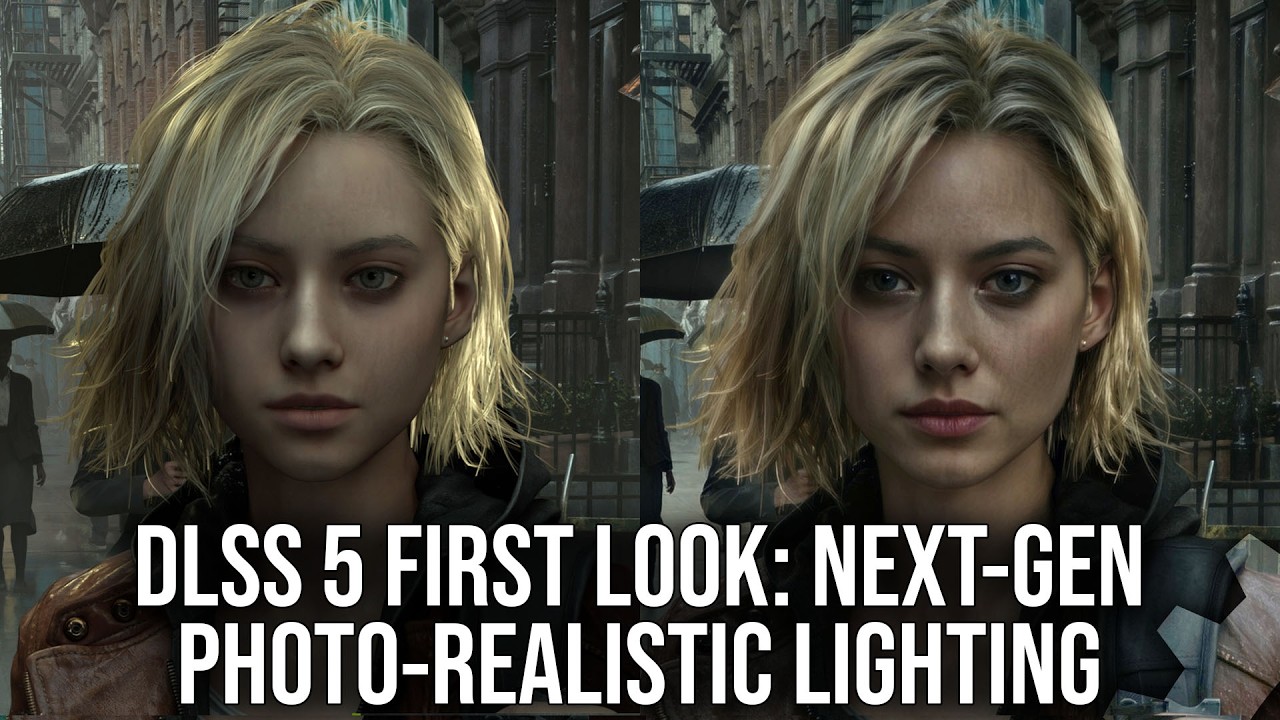
In games like Resident Evil: Requiem and Oblivion Remastered, scenes change noticeably with more detailed and accurate shadows, sharper contrast in lighting and a more "photorealistic" look to things.
However, there's absolutely no escaping the elephant in the room here: the system as it works now also appears to be able to change character models' appearances, and indeed the lighting choices generally made by developers in the first place. Moreover, it's questionable whether these are actually upgrades at all.
In the case of the comparison image that has most seized people's attentions, the main character of Resident Evil: Requiem, Grace, is rendered with a whole heap more detail in her hair and eyes once DLSS is applied, as the image below shows. She's also, though, given a much heavier pass of make-up (see her redder lips), looks older and has a clear sheen of the uncanny generic AI influencer vibe about her. This isn't a great look for DLSS 5, to put it bluntly.

Now, Nvidia has clarified that all of the implementations of DLSS 5 that it's shown off can be controlled by developers, so, in the case of the Grace comparison above, Capcom worked on the upgrade. That probably means the aesthetic faults in this case can be laid at Capcom's door, but it's a confusing choice of showcase either way.
As an Nvidia spokesperson put it to me, "developers and artists have full control and are given detailed controls for intensity, colour grading and masking, so artists can determine where and how enhancements are applied to maintain each game’s unique aesthetic."
The fact that this is all running in real-time is also technically unbelievably impressive, of course. Nvidia was running the demos on a two-GPU system, with one of its RTX 5090 cards running the games and another 5090 entirely dedicated to running DLSS 5, but it says the final, much more optimised version should launch in 2026 for 50-series cards without needing that sort of power.
Comparisons later in the video showing the ambient lighting in Oblivion Remastered and Starfield are perhaps simpler to assess, since they show how maps and locations can be gussied up a lot by the lighting filter. Even then, though, I'm not entirely convinced.
While Starfield suffered from lacklustre lighting and therefore makes an easy case study to show an upgrade, I don't think the same is true of Oblivion Remastered. Many of the changes shown off are just aesthetic differences, rather than pure, objective upgrades – and it's entirely justified to be concerned about this eroding the artistic direction laid out by developers intentionally the first time around.
I don't really want my fantasy townscapes to look exactly like they would under the real-world rules of sunlight's specular effects, or whatever. I want them to look fantastical, unknown and different, and crucially, I want them to look how they were intended to by dedicated developers. As Nvidia has pointed out, of course, they're still theoretically in control of the DLSS 5 implementation, but the examples shown off so far don't fill one with confidence.
You only have to check the YouTube comments under Digital Foundry's video to see how the tide of public opinion is going on this one, too. Nvidia will probably be aghast at the reception so far, with comments like "'Apply the slop filter please', said no one ever', attracting tens of thousands of likes.
I'll keep the jury out for now, to be fair. Plenty of technical experts rail against frame generation, while I've found it an extremely neat solution to help get more from people's gaming rigs, so I'm far from a Luddite on Nvidia's many AI systems and features.
There's no getting away from the fact that DLSS 5 leaves me feeling leery, though. At a time when developers seem to be under more pressure than ever for their games to sell silly numbers or face being replaced by AI shortcuts, it doesn't feel like the best PR move to show off this sort of open AI filter, regardless of its technical merit.
