Hilleberg Soulo Red Label Tent review: a gold standard in portable resilience
Unshakeable camping performance for adventurous adventurers

The Hilleberg Soulo is a superbly engineered four-season solo tent that delivers high levels of confidence in harsh weather conditions. Its bomb-proof materials, taut structure and all-season design make it a dependable refuge when conditions turn ugly. Though heavier and pricier than most one-person shelters, the Soulo’s stability, durability and storm-worthiness justify the investment for backpackers who prioritise reliability over a few extra grams.
-
+
Exceptional cool weather performance
-
+
Strong and stable in high wind and snow
-
+
Durable materials and meticulous build
-
+
Freestanding and a doddle to pitch
-
+
Pitches inner and outer flies in one go
-
-
A little heavier than ultralight alternatives
-
-
Overkill for fair-weather or casual summer trips
-
-
Some inevitable condensation concerns given how well it's sealed
-
-
More expensive than most solo tents
Why you can trust T3 Our expert reviewers spend hours testing and comparing products and services so you can choose the best for you. Find out more about how we test.

In the arena of backpacking tents, there’s one brand that consistently rises to the top of the review ratings, especially when it comes to camping in extreme weather conditions.
That brand is Hilleberg, a family-owned company based in Sweden that specialises in the manufacture of robust, high-altitude weather-resistant tents for adventurous backpackers, mountaineers, expeditionaries, off-piste bikepackers and kayakers.
I recently took delivery of the company’s popular Red Label Soulo model, a one-person, all-seasons tent designed mostly for autumnal and winter camping in areas where the weather can turn from gloriously sunny to a raging squall in mere minutes.
So what’s so good about the Soulo and why do the vast majority of its users rate it so highly? That’s what we’re here to find out.
Hilleberg Soulo Red Label Tent review
Price and availability
The Red Label Soulo is not cheap to buy, though there are some good deals to be found. If you purchase the tent directly from Hilleberg in Sweden, expect to pay £748 + VAT (£897) and delivery costs.
Alternatively, try some of Hilleberg’s UK dealers, including AlpineTrek (£892.95), Valley+Peak (£1,109.99), Taunton Leisure (£1,110) and Ultra Light Outdoor Gear (£1,039.99).
If you live in the USA, head to Barney’s Sports Chalet or Go Hunt where the Soulo sells for $995.
What’s so special about Hilleberg tents?

A section of fabric swatches from Hilleberg's Kerlon range
I’ve been reviewing tents and camping equipment since the 1990s, but I’ve never got around to checking out anything from the highly-regarded Swedish Hilleberg brand. Having covered so much gear over the years, I’ve become extraordinarily pernickety when it comes to the quality of the products I’m sent for review.
Most of the time, I’m commissioned to write a review of whatever comes my way (good or bad), but if it’s of my own volition, I do a remarkable amount of research first to get an idea of why so many others – reviewers and users – rate a particular product so highly. I then bite the bullet and call in a product loan sample to see what all the fuss is about.
That’s been the case with this review because I’d say that every user and pro analysis of practically any tent in the vast Hilleberg range has been almost unanimously positive. However, I will admit that most reviewers also mention the high prices of Hilleberg’s wares.
I mean, around £1,000 for a one-person tent? That’s not cheap by any stretch of the imagination. So what’s Hilleberg’s secret sauce, and why are their tents more expensive to buy than others?
First and foremost, Hilleberg tents are designed with durability and longevity in mind. We’re not talking a weekend summertime session on a campsite with ablutions, cafe and nighttime entertainment, though they do produce a line of tents that are perfectly suitable for such scenarios.
For the majority of the company’s models – specifically those in the Red and Black label categories – we’re talking halfway-up-a-mountain stuff in a raging storm with howling winds and horizontal rain belting the bejesus out of anything in its path. The kind of weather-related scenario that can spell doom if a tent should explode in tatters at 3 A.M., with two feet of snow piling up outside.
Every tent in the Hilleberg range is built in the company’s own facilities in Estonia, and every individual tent is signed off by the sewing technician who made it. That same tent is then erected for quality control inside the factory and inspected by someone else before it’s boxed up for export. This level of accountability inevitably slows production but dramatically increases consistency, as many Hilleberg users have noted.
Furthermore, Hilleberg is renowned for only using the very best and most expensive materials the company can get its hands on. Take their proprietary Kerlon fabrics, for example. They sent me a comprehensive brochure with the Soulo tent I’m reviewing here, and it contains a selection of Kerlon swatches (each one with a scissor cut), along with a swatch of ‘commonly-used’ ripstop material that many other manufacturers might use.
After a couple of attempts, I managed to rip a decent swathe of the commonly-used stuff, but I absolutely could not budge the Kerlon 1000 or Kerlon 1200 (as used for the Soulo), let alone any of the other, even tougher samples. For the record, the Kerlon range spans several levels of strength, from Kerlon 1000 to Kerlon 2500.
These fabrics deliver exceptional tear strength for their weight – often several times that of commonly used polyurethane-coated nylons. This is the type of material you could accidentally puncture with your crampons, and the perforations will not budge. It’s exceedingly waterproof, too. For instance, the Hilleberg Soulo we’re looking at here sports a hydrostatic head of 5,000mm for the flysheet and a robust 15,000mm for the floor. That’s about as good as it gets.
As a result, Kerlon fabrics are much more expensive to produce and are allegedly harder to sew. A similar story applies to the company’s DAC aluminium poles, heavy-duty guy lines and points, rain gutters and reinforced areas. Nothing here is made from cheaper options, so the result is a lot of expensive gear that stays intact after years of Arctic winds, mountain storms and high levels of UV.
Hilleberg clearly doesn’t cater to the budget weekend camper. Instead, the company’s core audience includes committed four-season backpackers, polar travellers and mountaineers who value reliability far above price.
Because that market is inevitably smaller and expects top-tier performance, Hilleberg clearly invests heavily in durability and craftsmanship, and the cost of its products reflects the level of care expected from the kind of gear that could quite literally save one’s life.
For most people, a mid-range tent is more than adequate. But for users heading into hostile, remote or unpredictable environments, Hilleberg’s premium pricing buys something that’s difficult to quantify but is absolutely vital when the going gets tough – trust. That’s why these tents are so expensive – you get what you pay for.
Understanding Hilleberg’s colour-coded tent labelling system
Black Label
To make it easier for prospective buyers to choose the right tent from a bewilderingly large range, Hilleberg has created a selection of colour-coded product categories. The Black category is the true all-weather winter option, built with the toughest, heaviest materials designed to withstand a blizzard in the Alps or a raging mountain-top rainstorm. If you’re trekking off-piste in very cold weather and don’t mind hauling more weight (around 2.8kgs) for bomb-proof reliability, this is the option for you.
Red Label
These tents are for year-round use and suitable for high-altitude backpacking during spring, autumn and winter, temperatures and snowfalls permitting. Red Label tents are also suitable for most high-altitude camping in the UK during summer. They are not as heavily built as those in the Black label range (around 1.8 kgs) and are therefore more easily carried a fair distance. The Red Label Soulo we are reviewing here uses Kerlon 1200 fabric, though a Black Label version using Kerlon 1800 is also available.
Yellow Label
If you’re backpacking in spring, summer or early autumn, opt for a tent in the Yellow Label range. These tents are the perfect weight for long trekking trips, though they're not suitable for winter use in colder climates. A model like the one-person Niak weighs just 1.7 kgs.
Blue Label
Blue Label tents are designed for all-season group use, whether for sleeping together or as a gathering shelter. At around 11 to 26 kilos, these 6- to 14-person shelters are best transported by vehicle.
Specifications
- Seasons: 4
- Style: Dome
- Sleeps: 1
- Pack size: 43 x 17cm (16.9 x 6.7in)
- Packed weight: 2.4 kg (5lb 5oz)
- Floor area: 1.9 m² (20.5 ft²)
- Vestibule area: 0.6 m² (6.5 ft²)
- Inner tent height: 95cm (39.4in)
- Canopy Fabric: 30D Kerlon 1200 with silicone treatment
- Floor fabric: 70D nylon
- Rainfly Hydrostatic Head: 5,000mm
- Floor Hydrostatic Head: 15,000 mm
Pitching process
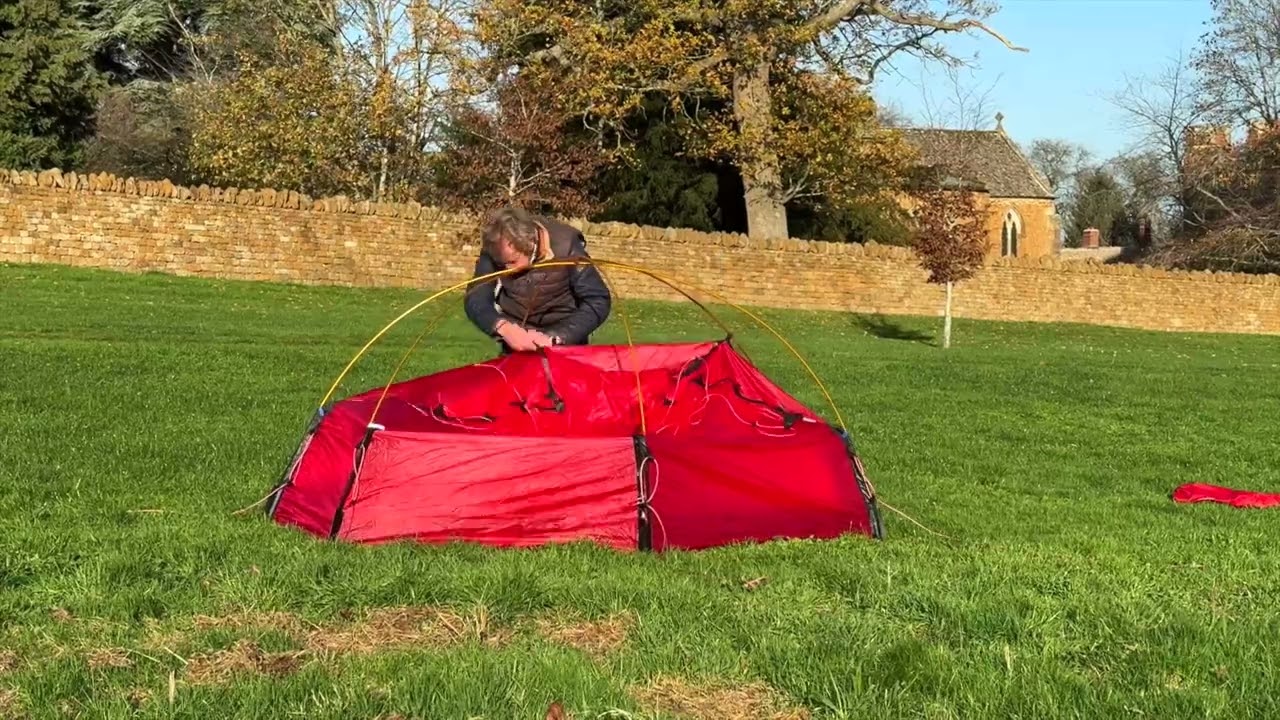
I can’t think of a more intuitive tent to pitch than this little tyke. Firstly, the bag that the tent, its poles and pegs come in is oversized, so no matter how badly you fold it up, you can be sure it’ll all fit back in with ease.
Like the similarly excellent MSR Hubba Hubba NX 2-person, 3-season tent I recently reviewed, the Soulo is a freestanding tent which can be moved around the pitch or its position changed according to the wind direction when fully erected.
However, unlike the MSR, which pitches the inner-tent first, this one pitches with the inner tent attached and, if you’ve opted for one, the optional footprint groundsheet, too. This means that the inner tent will never get wet when pitching in the rain. And since the Soulo is erected from the ground upwards, no amount of wind will ever affect the pitching process (see video above).
Forget checking an instruction manual because you really won’t need one. If it's windy, I would suggest pegging down the four corners of the tent first to prevent it from blowing away.
Now simply feed the two long poles into the robust sleeves on all four corners and do the same thing using the shorter pole across the centre. Voila, you now have a three-pole construction to which you can attach the myriad of sturdy C clips.
To do this, walk around the tent while you attach two to three clips at a time. Finish off by attaching as many guy lines – there are 12 of them – as you think you’ll need, and that’s it. It really couldn’t be any easier.
Aside from the ease of pitching, what especially impressed me during the assembly process was the precise fit and finish of every panel and connection point. Everything snapped into place to create an extremely taut dome with absolutely no creases anywhere. Very satisfying.
Design and comfort

The Hilleberg Red Label Soulo (meaning ‘island’ in northern Scandinavian Sami) is an asymmetrical one-person, four-season shelter aimed at autumn-and-winter backpackers, solo alpinists, adventurous bikepackers, kayakers and anyone who needs a small, bombproof refuge for when the weather turns nasty.
The red colour I received makes the tent very easy to spot in whiteout conditions, which is a welcome safety consideration when used in winter. It also looks ravishingly good in red. However, the Soulo is also available in dark green and brown for campers who prefer their tents to meld into the landscape.
For those who require even more sturdiness against the elements, the Soulo is also available in the Black Label range, with tougher Kerlon 1800 fabric and slightly thicker poles.

This tent has a tidy, compact footprint, and because it’s freestanding and pitched as one with an inner tent pre-attached – including the optional footprint groundsheet for added floor protection – you can not only move the Soulo around once erected, but it can also be pitched in driving rain without anything getting wet on the inside. And that’s worth its weight in gold, which in this instance is 2.4 kilos.
In the pantheon of backpacking tents, that’s about a kilo more than most 3-season models, but you have to remember that we’re talking about a 4-season tent here, one that has been demonstrated time and again to withstand the worst that nature can throw at it. Yes, it will feel heavier in the backpack, and you might not be able to travel as far without stopping for a rest, but that’s the price one pays for peace of mind when the weather suddenly goes pear-shaped.

Inside, this tent is as cosy as cosy can be, with more than enough space for a solo camper. I measured the Soulo’s inner length at very close to 2.24m (7.34 feet). However, because there’s some inevitable vertical sloping on the head end when sleeping, someone taller than six feet may find that their head touches the inner fabric when sleeping.
The width of this tent at its widest point is 100cm, and that means there’s a decent amount of space to the side for loose clothing and other accoutrements. Since the inner living area tapers at the ends, I measured 70cm of width at the head end and 60cm at the foot end. In a nutshell, there’s more than enough space to sleep comfortably and store essential gear under cover, plus some smaller items in the two provided side pockets.

The Soulo's inner dimensions are perfectly suitable for any standard camping cot, including those from the Helinox brand
As a bonus for car and bike campers who are able to carry a little more, the Soulo's sleeping area also easily fits a standard Helinox camping cot like the Helinox Cot One Convertible. Rather handily, the cot can be assembled outside the tent and simply popped inside when both inner-tent entrances are unzipped. Believe me, having a cot along for the ride adds a whole new level of comfort, especially if pitching on stony ground.
In terms of head clearance, this model has 95cm of headroom, which could be a bit tight for taller folk. I’m 5’6”, and my head has four inches of clearance when sitting with my bum on the floor in the most central position.
When kneeling, however, I have one inch of clearance in the centre, but the top of my hair brushes the top of tent when sitting a little further back. For my height, these dimensions are just fine, perfect even.

While not the largest of vestibules, there's enough storage space for a solo backpacker
The triangular vestibule space, too, is usefully sized for a single person to stash wet boots, backpack and cooking kit while keeping the sleeping area bone dry. You could feasibly cook here, too, if you unzip most of the rain fly for ventilation (a must if cooking with gas). This area also benefits from having the optional footprint groundsheet, which I wholeheartedly recommend.
The Soulo comes with one expandable inner doorway with an integrated mesh panel, and it’s very well designed to allow entrance and exit with little hassle. Comprised of two zips on the left – one vertical, the other horizontal – the inner door can be opened halfway during inclement weather or, if using the third horizontal zip on the right, fully opened for appreciating any fine views.

The main zipper features a plastic guard to keep driving rain at bay
The Soulo’s outer doorway has a single vertical zip that’s covered its entire length by a robust plastic rain guard. Simply roll up and attach the outer fly’s door to the elasticated tag to keep it secure. And fear not if the wind’s battering the front because there’s a small floor-mounted tab attached for securing the zip’s pull tab. These Hilleberg folk, it seems, have thought of everything.
Features and build quality


Let’s get down to the Soulo’s features, materials and overall build quality. Crucially, the asymmetric geometry of this tent keeps the profile low for high winds while still offering enough internal space to fend off any feelings of claustrophobia.
The Soulo’s dome construction is comprised of multiple pole crossing points that provide exceptional rigidity, superb rain protection and an impressive ability to handle large dollops of snow.
The poles themselves are of the 9mm DAC Featherlite NSL aluminium alloy variety, and they’re pre-bent for easier pitching and reduced stress. You get two 3.44m poles for the corners of the tent and one shorter 2.85cm pole for the centre section – all six ends fit snuggly into a set of long, reinforced sleeves for ease of pitching and, more importantly, insane levels of sturdiness.
I also love the quality of the pole clips and reinforced webbing that spreads any stress at the contact points over a wide four-inch area. In fact, if you spend a little more money, you can buy a second set of poles and have both sets installed for unbridled strength in very high winds.
Hilleberg’s tents are known for using high-quality technical fabrics and for treating their fabrics to balance strength, weight and weather resistance. The Soulo’s outer Kerlon 1200 fabric has a microscopically tight weave that is impossible to rip while still being light enough to suit any wilderness adventures. Helleberg's Kerlon 1200 (equivalent to 30 Dernier ripstop) is triple-coated with silicone to produce a hydrostatic head of 5,000. It’s treated for UV resistance, too. A separate clip-on canopy is also included for extra rain resistance.
If the outer tent’s fabric is outstandingly weather poof, the inner tent’s floor section is even more robust, sporting a hydrostatic head of a magnificent 15,000. As you would expect from a brand that doesn’t compromise in any areas, all seams are factory-sealed, and all stress points use heavier webbing and reinforced fabric patches. Even the inner tent has some form of treatment for water repellence.
This tent comes with 18 peg points: six ground anchoring points and 12 guy points on the outer fly. However, you only get 12 super lightweight aluminium V-shaped pegs in the bag, so opt for another six in case you ever need them.
At this point, I must give a resounding shout-out to the robust, tangle-free nylon guy lines. There is no need to tie these up when packing up because they will not tangle. Instead, chuck them willy-nilly over the centre of the canopy when disassembled, and they’ll be ready for a quick pitch at your next location.
Since this tent is ostensibly designed for cold-weather use, the outer flysheet is completely flush with the ground. This helps the tent retain heat in cold weather at the expense of retaining internal moisture, or condensation as we know it (I’d say the internal temperature is 2˚C to 4˚C warmer inside than it is out, and that’s a major bonus when the temperature’s plummeting).


Granted there is a large triangular ventilation hole on top of the outer fly which you can unzip to create better airflow to reduce condensation, and you can improve on this by unzipping the inner tent’s doorway to expose the full meshed section, too.
However, because the tent is so well sealed in general, it’s impossible to completely eradicate condensation in really cold weather, so always carry an absorbent chamois or cloth to carefully wipe the inside of the inner tent from time to time.
This is especially important when the wind is blowing, as it can cause condensation droplets to fall on the occupant. Personally, I’d have liked to see a second vent on the other side to increase airflow through the tent. But then two vents would let in even more cold air, and I’d rather deal with some internal dampness than freeze like an ice lolly.
If you value expert engineering and premium finish, the Soulo delivers on all fronts. The seams are straight as a ruler and exceedingly well-taped, with attachment points and guy-line anchors that are reinforced in all the right places for stress reduction and long-term durability. In short, the build quality here is faultless and to an astonishingly high standard throughout.
Performance


Where the Soulo has earned its five-star reputation is during real-world use and, heaven knows, there are enough videos out there with users heaping high praise on its ability to withstand the elements.
I’ll admit that I didn’t take this tent up a mountain during a storm, partly because there are no mountains in Oxfordshire but mostly because I’m a wimp when it comes to hardcore mountain camping. I do know my tents, though, and this model has impressed me on so many levels.
In high winds of 40mph-plus, the tent’s low, taut profile and well-placed guy points give it confidence-inspiring rigidity while the sloping panels encourage snow to slide rather than accumulate. And when temperatures plunge, the Soulo holds in warmth better than any lightweight summer tent could – and without it becoming unbearably stuffy.
I know this because I spent quite a while in it in a field during a -1˚C cold snap. Yes, some condensation had gathered after spending time in it, but the triangular vent certainly helped keep it moderate.
I’ve seen one scary video of this tent withstanding a full-blown mountain storm with gusts of up to 73mph. Naively, I tried to recreate some semblance of wind myself using two high-powered leaf blowers, and I feel like a right twit for even attempting it. While the air pressure pushed the outer fabric inwards, the tent and the poles never budged. Of course they didn’t! What was I expecting?
I then tried a waterproofing test by blasting the side of the tent with a hosepipe on the jet and sprinkler settings for five minutes. I basically aimed at all areas, including under the outer tent’s small, top-mounted canopy, expecting at least some droplets to appear on the outer tent’s optional groundsheet footprint, but I’m pleased to say that it was bone dry.
I’ve never been a big fan of one-person tents when a two-person option offers so much more internal space, albeit at the expense of a little more weight to carry. But this model has sold me on the concept. After I’d kitted it out with a soon-to-be-reviewed NEMO Tensor All-Season Ultralight insulated sleeping pad and Big Agnes Fly Creek UL 25° sleeping bag, I didn't want to get out. It just felt so wonderfully cocooning, cosy and safe – and that was when it was set up in the garden!
I can now easily see why so many hard-core campers have gone for the Soulo, along with a slew of other Hilleberg models. Its impeccable build quality, clever design and choice of superior materials instil a high level of confidence when going it alone in the great wide open.
Verdict

The Hilleberg Soulo Red Edition is a refined one-person all-season tent that can withstand most of what nature can throw at it. If you spend time soloing in winter, heading into high winds, or touring where repair options are few and far between, the Soulo’s build quality, expert material choices and proven design flourishes inspire a huge amount of confidence.
That said, this tent isn’t for everyone. If your trips are mostly comprised of short summer weekend camps where every gram matters, the Soulo will feel like overkill. But if your priority is a tent that will keep you safe, dry and relatively comfortable when the weather turns crappy with a capital C, this is a shelter that will likely become a trusted piece of your kit for years and possibly decades.
