Philips ReAura review: The LED mask that adapts to different areas of your face and neck
I tested it for eight weeks, and here's what happened


The Philips ReAura has impressed me more than I expected, particularly with how thoughtfully it's designed. After eight weeks, I noticed my skin looking healthier and glowier, with blemishes becoming less noticeable around week six and some fine lines appearing softer by week seven. There are a few things I'd change, including the basic controller and the beige-orange colour, but neither overshadowed my overall experience. It's certainly an investment, yet if you want an LED mask that can treat multiple areas without complicating your skincare routine, the ReAura is a great choice.
-
+
Clever 3-in-1 design covers the full face, eye area and neck
-
+
Easy to switch between configurations
-
+
Lightweight, flexible silicone
-
+
Premium feel
-
+
3 guided treatment modes
-
+
Fine lines appeared less noticeable around week seven
-
+
Suede storage bag
-
-
Results take longer than advertised
-
-
Controller has no display
-
-
Beige-orange colour won't appeal to everyone
Why you can trust T3 Our expert reviewers spend hours testing and comparing products and services so you can choose the best for you. Find out more about how we test.

The best LED face masks are evolving quickly, and we're seeing more models that do more than just treat your face. Philips is one of the latest brands to get in on the action, launching the Philips ReAura LED Face Mask in August as its first-ever LED face mask.
What makes the ReAura stand out is its flexible 3-in-1 design, which lets you treat your full face, eye area or neck separately. I've tested all three treatment areas over the full recommended eight-week period, and here's how I got on.
Price and availability
The Philips ReAura LED Face Mask has an RRP of £349.99/€399.99, although it hasn't officially launched or been priced in the US. You can currently get 15% off through Philips' website with the code LED15, bringing the price down to £297.49.
It's also available through Amazon, where a similar discount is offered.
Design and features
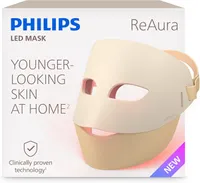
The Philips ReAura has a 3-in-1 design that lets you treat your full face, focus on the eye area or target your neck without needing separate devices or attachments. For a full-face treatment, the two sections connect together and are secured with the main mask strap. You can also use the upper section on its own for the eye area, whilst the lower section detaches for targeted neck treatments using the included neck strap.
Philips has also built in eye protection to block light from reaching your eyes, whilst the lightweight design makes the mask easy to wear and take away with you.
It's controlled by a separate rechargeable unit that connects to the mask during use, which charges via the included USB-C cable. This takes up to six hours to fully recharge and it provides up to eight treatment sessions per charge.

The ReAura uses three LED wavelengths – 415nm blue light, 630nm red light and 830nm near-infrared light. These are combined into three treatment modes, each designed for different skincare concerns. Age Care combines red and near-infrared light to help reduce the appearance of fine lines and wrinkles, whilst Blemish Care combines blue and red light to target the appearance of blemishes and redness. Daily Glow uses all three wavelengths in shorter sessions to help maintain a healthy-looking glow.
Philips recommends using the mask every other day, with Age Care and Blemish Care sessions lasting 10 minutes and Daily Glow treatments taking just five minutes. For the recommended treatment periods, Philips advises using Age Care for at least eight weeks and Blemish Care for at least four weeks, whilst Daily Glow can be continued for as long as you like.
Performance
After testing the Philips ReAura for eight weeks, the first thing I fell in love with was the design. I initially expected the 3-in-1 setup to be complicated, but its magnetic attachments make it easy to switch between configurations, which was a relief. The overall feel is premium, and although I'm not sold on the beige, orangey colour, the silicone itself feels wonderfully smooth. The mask is lightweight and comfortable to wear, and it also comes with a suede storage bag, which is great for storage and travel.
What I particularly like is that you're not limited to treating your face as a whole. You can detach the lower section and use it on your neck separately, which is useful if you want to give that area some extra attention on days when you don't use the full mask, or vice versa. It's a very clever design, and one that makes the ReAura feel a little different from the LED masks I've tried before.
Due to the mask's shape, the lower section doesn't sit completely flush against the skin. However, this isn't a bad thing as the gap helps provide more even light distribution and broader coverage – so don't worry if you notice a little space between your face and the mask!


The other thing I've really appreciated is the guided treatment system, which makes the whole experience much less intimidating, particularly if you're new to LED skincare. I also love the Daily Glow mode, which offers a shorter treatment you can use to maintain your routine after completing the initial 6-8 week courses.
During testing, I used both Age Care and Blemish Care, sticking to Philips' recommendation of treating my skin every other day. I'm approaching my 30's, meaning I still get the odd spot and blemish, but I'm also starting to notice fine lines more and more. This makes it interesting to see how the mask would perform across both concerns.
After the first couple of weeks, I noticed my skin looking a little glowier and healthier, which is usually one of the first things I notice when using LED regularly. However, when I reached the four-week mark, which Philips recommends as the minimum treatment period for Blemish Care, I was still seeing most of the blemishes I'd started with. I stuck with it though, and began noticing more of a difference at around the six-week mark.
Age Care took a little longer to show visible results. It wasn't until around week seven that I noticed some of my smile lines looking less defined, whilst the slight puckering around my jawline also appeared less noticeable. These are subtle changes rather than a dramatic transformation, but they're the sort of gradual improvements I'd expect from an LED mask. My advice would be to give it time and not get disheartened if you're not seeing the results you hoped for after four weeks or less.

The controller is perfectly straightforward to use, although the lack of a display means you'll need to remember which mode you've selected. There's also no timer showing how much treatment time you have left, which is something I've appreciated on other masks I've tested. Neither issue is a dealbreaker, but a little more feedback from the controller would make the experience even better.
One smaller detail I really appreciated was the silicone straps. Plenty of LED masks have a comfortable face covering but let themselves down with plasticky Velcro straps. The ReAura's silicone straps feel much nicer against the head and are comfortable to wear throughout a session. The neck straps are great too, as you can simply pop them on rather than having to thread them through loops, making it much easier to switch between neck and lower-face treatments.

Finally, one thing worth mentioning is that the ReAura doesn't appear to have as many LEDs as some other masks I've tested. Philips doesn't disclose the exact LED count, and it's worth remembering that the number of LEDs alone doesn't determine how effective a mask is. Irradiance – the power density reaching your skin – and the accuracy of the wavelengths are much more important factors. Still, I'd like to see Philips provide more transparency around the LED configuration, and potentially increase the number of LEDs in a future model. For now, it's something I'd like to know more about, rather than a reason to dismiss the mask outright.

Verdict
The Philips ReAura has impressed me more than I expected, particularly with how thoughtfully it's designed. After eight weeks, I noticed my skin looking healthier and glowier, with blemishes becoming less noticeable around week six and some fine lines appearing softer by week seven. There are a few things I'd change, including the basic controller and the beige-orange colour, but neither overshadowed my overall experience. It's certainly an investment, yet if you want an LED mask that can treat multiple areas without complicating your skincare routine, the ReAura is a great choice.
Alternative to consider
The overall setup of the ReAura reminded me a lot of the Shark CryoGlow, particularly its approach to guided treatments. Having the mask handle the sessions for you, rather than having to work out which light colour to use and for how long, makes the whole process much more straightforward. The ReAura and CryoGlow are similar in that respect, although Shark's newest Face + Body model offers a little more versatility in how you use it.