Bluesound Pulse Cinema Mini review
High-quality soundbar audio for your smaller-scale TV? Sorted!
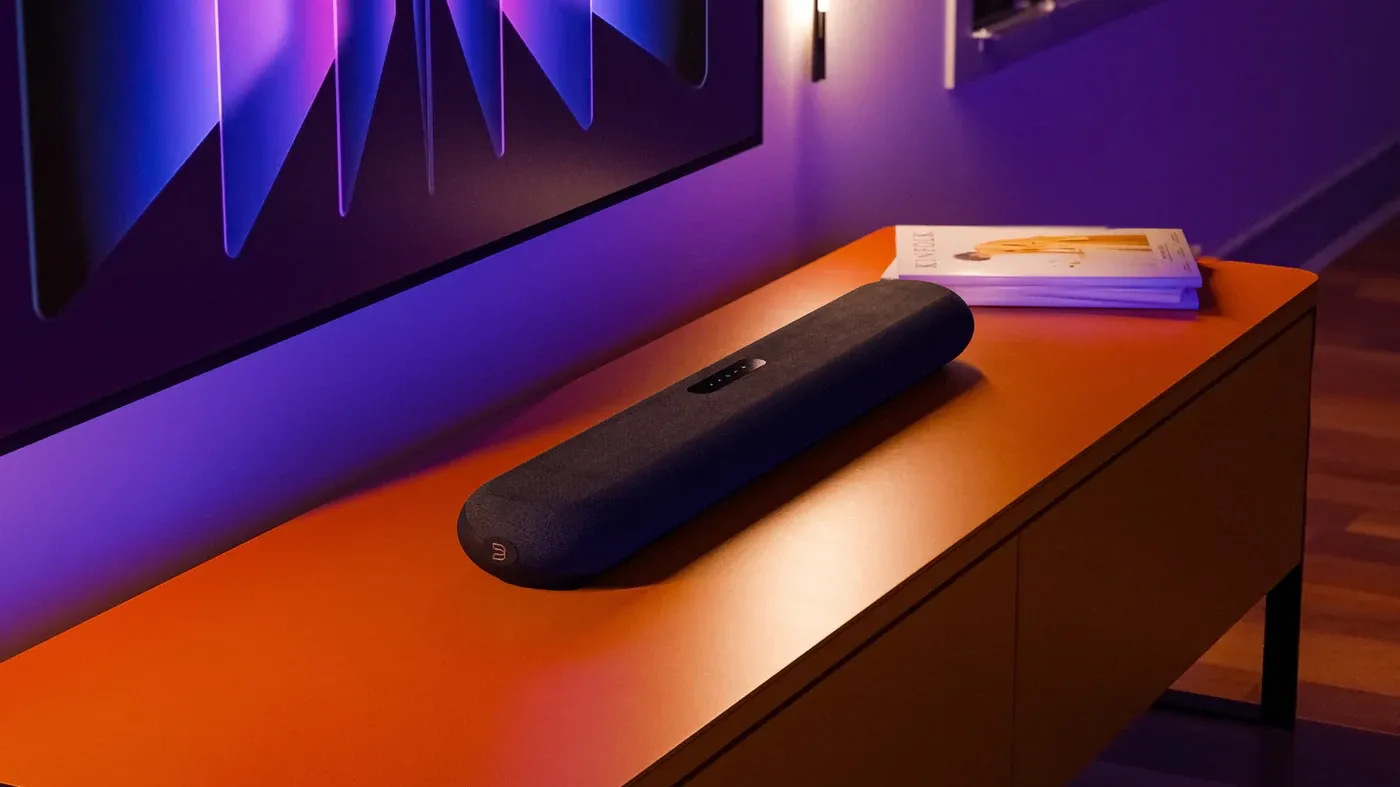

Those who have a smaller TV that needs a big audio upgrade will find the Bluesound Pulse Cinema Mini a compelling option. That's especially true if you have plans for a multi-channel or multi-room sound system. The rest of us, however, will have to factor in the relatively high price and the relatively compact (though accomplished) sound before committing.
-
+
Punchy, direct and organised sound for movies and music
-
+
Dynamic and unified presentation
-
+
+ Standard of design, build and finish all impress
-
-
Could conceivably sound more expansive
-
-
A remote control would be nice
-
-
Seems rather expensive
Why you can trust T3 Our expert reviewers spend hours testing and comparing products and services so you can choose the best for you. Find out more about how we test.

If you’ve got a big TV that needs a helping hand with its sound (and don’t they all?), you have a lot of big soundbars to choose from – the best of which can be large and imposing.
But what about if you have a smaller TV – like the best 42-inchers – but want a similarly big increase in sound quality? In the shape of the Pulse Cinema Mini, Bluesound thinks it has the answer.
Price & Availability
The Bluesound Pulse Cinema Mini is on sale now, and in the United Kingdom it’s priced at £799. In the United States the going rate is currently $999. While in Australia you’re looking at AU$1599.
The world is not short of similarly priced soundbars that aspire to deliver a sensation of Dolby Atmos spatial audio, of course – so the Bluesound will have to see off some very capable and credible opposition if it’s going to succeed.
Features & What's New?

Although it deploys digital sound processing to deliver virtualised height channels in order to credibly process Dolby Atmos spatial audio soundtracks, the Pulse Cinema Mini is arranged as a 2.1-channel speaker.
It achieves this by using six drivers – two 21mm tweeters, a couple of 45mm midrange drivers and a pair of 102mm bass drivers – supported by two 102mm passive radiators and driven by a total of 282 watts of Class D power. Each tweeter and each midrange driver gets 38 of these watts, while each bass driver receives 65 watts.
There’s a tweeter and a midrange driver at each curved edge of the front of the soundbar, angled out to create some audible width, while the two bass drivers and the two passive radiators are on the ‘bar’s top surface.
Getting audio information on board in order for it to be decoded and amplified can be done in a few different ways. There’s an HDMI eARC connection in a recess at the rear of the soundbar, and here you’ll also find a USB-A slot, an Ethernet socket, a Toslink input and a pair of stereo RCA analogue inputs – there’s a pre-out for use with a subwoofer in this recess, too.

In addition, the Pulse Cinema Mini features dual-band Wi-Fi and Bluetooth 5.2 with aptX Adaptive codec compatibility – it’s a Bluetooth transmitter as well as a receiver, and it can wirelessly connect to the company’s Pulse Sub+ subwoofer.
No matter how you get your audio content on board, though, it’s pored over by a DAC chipset (that's a digital-to-analogue converter) operating at a native 24bit/192kHz / DSD256 – which is very high-end indeed.
It’s capable of coping with all worthwhile file formats – from AAC and MP3 to FLAC and MQA, as well as most points in between – and can deal with Dolby Digital/Plus, Dolby True HD, Dolby Atmos and LPCM multichannel formats too. As is becoming increasingly common in products of this type, though, there’s no DTS compatibility.
The Pulse Cinema Mini is also Roon Ready, and its third-party integrations extend to AirPlay 2, the ‘Connect’ versions of Qobuz, Tidal and Spotify – and there’s support for Spotify Lossless too.
Performance

In the sonic face-off between the Bluesound Pulse Cinema Mini’s big price-tag and small dimensions, it’s the dimension that win. But only just. It’s almost a split decision – because though this soundbar doesn’t sound quite as expansive or immersive as you might be hoping, it’s got a whole lot going for it in every other respect.
For starters, when playing a Dolby Atmos soundtrack, its presentation is brilliantly unified and quite tightly knit. The soundstage it creates has width and height, certainly, but what’s more apparent is how together, how of a singular occurrence, the sound is.
Sound effects move with positivity around the stage, and there’s plenty of dynamic headroom available for when an action-movie set-piece kicks off – but everything on the stage relates to everything else and nothing sounds remote or distant. You may not ever quite feel inside the sound of the Pulse Cinema Mini, but you’ll never doubt its composure or fidelity.
At the top of the frequency range the Bluesound summons a carefully considered amount of bite and shine, but balances it nicely against plenty of substance for treble sounds.
At the bottom end, it digs respectably deep and hits reasonably hard – but just as significant is the amount of detail and variation it manages to load into bass sounds.

Some soundbars think their job is done if they can create sufficient punch, but the Pulse Cinema Mini is more judicious than – it controls its low-end activity to the point that bass doesn’t hang around or drag at the rest of the frequency range. Instead, it snaps.
And when you consider the Bluesound has no dedicated centre channel to deal with voices in the midrange, it’s remarkably forward and eloquent where voices are concerned.
At every stage of the frequency range, response is even-handed and tonality is quite carefully neutral. Both of these characteristics further enhance the impression of singularity and togetherness that the Bluesound creates.
Switch to music and the story is, broadly speaking, very similar. Content mixed in Dolby Atmos can escape the physical confines of the soundbar in every direction – but not, perhaps, by as much as you might be expecting.
There’s a definite sense of spaciousness to the sound, though, and more than enough space on the nicely organised and controlled soundstage for each aspect of a recording to do its thing – and, again, real clarity and conviction through the midrange.
Even when you switch to plain-vanilla two-channel stuff, the control and organisation the Bluesound exhibits makes for a confident and quite positive rendition of your music.
Design & Usability

The Bluesound Pulse Cinema Mini is one of those increasingly rare soundbars: one that doesn’t look oversized beneath a modestly sized TV.
Bluesound, of course, will sell you the (longer) Pulse Cinema that’s more than 1.2m long – but this Pulse Cinema Mini is a much more manageable 85cm long, which means it doesn’t look daft sitting in front of my 48-inch Philips OLED TV.
And even though my TV sits quite low on its stand, the Bluesound is just 7.4cm high and 14cm deep – so it doesn’t foul the bottom of the screen and it can be positioned nice and close.
By prevailing soundbar standards, it looks quite decorative while it’s there (or, at least, it does in the black-on-black finish of my review sample – the pinky/brown ‘tan’ alternative with white plastic bits is a bit weird).
It’s a fairly pronounced ‘lozenge’ shape, with very nicely achieved curves at either end and beautifully applied acoustic cloth covering the area where the powered drivers are positioned.

The lack of a remote control is a slightly strange omission, but the Bluesound scores strongly when it comes to the BluOS control app.
This interface is about as stable, as logical and as comprehensive as these things ever get – and it means using the Pulse Cinema Mini as a music speaker, as part of a multi-room system or as an element in a true surround-sound system, is just as easy as it is to use it as a speaker to deal with your TV’s sound.
There are also a few touch controls on the top surface of the soundbar – here’s where you can deal with ‘play/pause’, ‘volume up/down’ and access a couple of presets you’ve defined in the app. A proximity sensor wakes these controls as you approach the soundbar.
You may prefer to use your voice to control things – and it’s possible, if you integrate the soundbar into Amazon Alexa Skills. It’s a bit of a roundabout way of getting some voice control, mind you.
Verdict

Those who have a smaller TV that needs a big audio upgrade will find the Bluesound Pulse Cinema Mini a compelling option.
That's especially true if you have plans for a multi-channel or multi-room sound system, and even more especially true if you admire a well-sorted user interface.
The rest of us, however, will have to factor in the relatively high price and the relatively compact – though admittedly very accomplished – sound before committing, though.
Also Consider
You can go one of two ways when you’re considering alternatives to the Bluesound Pulse Cinema Mini: either compare it to similarly priced rivals or compare it to rivals of similar size.
Where similarly priced rivals are concerned, you could do a lot worse than consider the Marshall Heston 120 – a bit more on the price of the Bluesound buys a far more expansive, far more immersive, far more downright bassy presentation as well as some very assertive looks. It's a big lad, though.
As far as similarly sized rivals go, you should investigate the Bose Smart Soundbar – it’s even more compact than the Bluesound, but does a manful job of sounding as large as it possibly can.
