Apollo Dash electric scooter review: Stunning entry-level e-scooter with features aplenty
If you’re in the market for a reasonably-priced and exceedingly well-endowed e-scooter for your travels, step right this way

The new entry-level Apollo Dash has the sort of effortless competence that makes other scooters look like they’re still waiting for the bus. It’s comfy, planted and nimble with large pneumatic tyres and a brilliant rubberised deck. It also comes with a shedload of onboard features, including a high-speed Ludo mode and a lighting system that’s borderline lighthouse territory. Highly recommended.
-
+
Expert build quality
-
+
Assured handling
-
+
Tons of features
-
+
Stunning lighting system
-
+
Where permissible, a top speed of 22mph
-
+
NFC compatible plus GPS tracking
-
-
Rear drum brake instead of a disk
-
-
Not as light as some other models
Why you can trust T3 Our expert reviewers spend hours testing and comparing products and services so you can choose the best for you. Find out more about how we test.

Where permitted, the electric scooter is unquestionably one of the most practical ways to get around town. It’s way quicker than walking, less effort than cycling and, for short journeys especially, it is considerably more convenient than taking the car or public transport.
Moreover, the ability to fold it away when you reach your destination is a major plus, particularly if storage space is at a premium.
Not every e-scooter hits the sweet spot between portability, performance, comfort, features and range, so if you're weighing up your options, T3's guide to the best electric scooters is a very handy place to start.
Or, if you live in parts of the USA and Canada, you could just take it from me and make an instant beeline towards Apollo’s brand new Dash, the Canadian company’s first lighter-weight, entry-level scooter for commuters and leisure riders.
I've been riding the keenly priced Dash for the past few days to see how well it handles the realities of everyday travel and storage, and I’ve been exceedingly impressed on so many fronts. Here’s my take.
Apollo Dash review
Price and availability
The Apollo Dash is priced at $699 in the US and is currently available to pre-order direct from Apollo, with deliveries expected from late October 2026 according to Apollo’s own tracker page.
The same timeline applies in Canada, the home of Apollo scooters, where the Dash retails for $849 Canadian dollars. According to Apollo, there are no set plans for the UK just yet so watch this space.
Specs at a glance
- Frame: Extruded chromoly steel
- Weight: 43lbs (19.5kgs)
- Motor: Bosch 1200W peak
- Battery: 48V 10Ah
- Tires: 9.5in PunctureGuard (self-healing) pneumatic tires
- Ride modes: Eco, Normal, Sport, Ludo
- Range: Up to 25 miles (40km)
- Max speed: 22mph (35km/h)
- Brakes: Regenerative braking + rear drum
- Indicators: Yes
- Display: DOT
- Waterproofness: IP66 (heavy rain, etc)
- Smart features: GPS anti-theft, NFC tap-to-unlock, Apollo app
- Folding: Around 10 seconds
- Max load: 220lbs (99kgs)
- Frame warranty: Lifetime
Why I think e-scooters are the future of personal mobility

The electric scooter is arguably the simplest and most effective form of personal mobility to arrive since the humble bicycle. Initially popularised by Razor and Segway in the 2000s and 2010s, the modern e-scooter provides an environmentally clean and fuss-free method of getting from A to B efficiently, whether it’s a full five-mile trip to work or a combination of a short trip to the subway station and another short stint to your place of work.
For me, the e-scooter’s biggest advantage is its combination of portability and practicality because it takes up very little space and can be easily folded for storage at home, popped into a shop or held in an upright and compact position if strap-hanging on the subway.
Likewise, e-scooters are considerably less cumbersome to carry than a bicycle – even if some of them top the scales at over 60lbs – and you don’t arrive at work dripping in sweat, particularly when moderate hills or longer distances are involved.
E-scooters also provide a sense of immediacy. You don't need to fret about finding a parking space, negotiating traffic is a cinch, and there's no complicated routine involved in getting ready for a journey. Simply roll it out, switch it on and vamoose. For many urban trips, I think that e-scooters offer an incredibly appealing – and liberating – level of simplicity.
Of course, e-scooters aren't perfect. You have to stand for the entire journey, battery range is finite, and their practicality depends entirely on road conditions and, more importantly, local laws. But when used appropriately, e-scooters occupy an amazing middle ground between walking, cycling and motorised transport.
For this e-scooter fan, the combination of convenience, compactness and effortless electric assistance makes it one of the most compelling and eco-friendly personal mobility inventions of the modern era, and I simply do not understand why some countries get so heated up about it. After all, cars have injured and killed thousands over decades, but no one’s ever considered banning them. Time for change, methinks.
Design and features

The feature-filled Apollo Dash arrived partly unassembled in custom-moulded polystyrene packaging replete with a well-written manual, a full set of Allen keys, two NFC cards and six mini screws for fixing the handlebar to the stem. My test model arrived with a 60% charge, so I hit the road immediately because I simply couldn’t wait to give it a whirl.
Apollo scooters is a Montreal-based Canadian brand renowned for its high-performance electric scooters, featuring advanced proprietary technology and premium build quality. While the Dash may represent the company’s first foray into a lighter-weight, entry-level commuter-based e-scooter category, it still shares the majority of the smart features you’ll find on its higher-end stablemates, and that’s a major plus in its favour right from the off.
The Dash is cast mostly from extruded chromoly steel and weighs a fairly substantial 43lbs (19.5 kg), which is par for the course for entry-level commuter scooters in this price range. Despite my petite stature, I’ve found it to be relatively easy to carry short distances, though taking it up a long flight of stairs could be a bit taxing for some.
The key takeaway here is that the Dash’s frame feels sturdy enough to shake off a lot of long-term punishment, and you really do need that in a scooter, especially one that may be used every day. Small wonder the frame comes with a lifetime warranty.

I’m especially enamoured of this model’s generous deck, which measures 18 inches (46cm) in length and 6 inches (15cm) in width. Furthermore, its thick rubberised coating provides oodles of grip no matter what type of shoes you’re wearing.
Granted, the handlebar’s thumb controls could be a little nearer to the hands when holding the outer section of the bar, but I’ve got used to it now that I’ve been riding it for a while.
Where many entry-level commuter e-scooters are fitted with 8.5-inch wheels that feel skittish at speed, this one comes with 9.5-inch wheels and the difference is night and day. Rounded and very grippy ‘self-healing’ pneumatic tyres, meanwhile, help reduce vibrations on poorly maintained blacktop.
Yes, full suspension like that fitted to Apollo’s Performance line-up would make a great difference to the ride but, hey, you can’t have everything at this price point. Besides, adding suspension adds a lot of extra weight, and this e-scooter is all about day-to-day practicality.

When it comes to electric motor power, Bosch is a dominant force in the e-bike industry, so it’s great to see one of its motors fitted here on a scooter. According to the specs, the front-mounted 600W motor produces a peak power of 1,200W, which really comes into its own on hills.
Apollo states a maximum gradient of a whopping 15˚ (26.7%) but I’m not wholly convinced that’s doable without using a leg to provide a few kicks. However, I can report that it had no issues climbing a hill that I estimated to be between 10% and 12%, and that’s steeper than I expected any commuter scooter to handle.
The 48V 10Ah battery, too, punches out some serious charge that’s capable of taking the Dash to around 25 miles in Eco mode, though it will take around five hours to fully charge from empty.

One of this e-scooter’s most striking features is the huge dot matrix display that shows which riding mode you’re in, your current speed and the amount of battery power remaining. Where some e-scooter displays are difficult to read while riding, this one cannot be ignored because the lettering is an inch-and-a-half tall and readable in even the brightest of direct sunshine.
Furthermore, there’s a built-in Quad Lock mount on the headset to which you can clip a Quad Lock-equipped phone case. I’ve used a few Quad Locks for my phone when riding some of the best e-bikes, and they are among the most reliable on the market.

Let’s delve into this model’s lighting system, which is surely one of the brightest and most effective on the market. On the front, you not only get a decent adjustable LED headlight with a long beam for seeing the road ahead, but also a rear always-on LED that flashes when the rear brake is applied.
The handlebar stem is also equipped with a 13.5 -inch bright white LED strip that can be seen from a very good distance away – Apollo says 500 feet, and I’ll take that. This is not only an aesthetically pleasing feature, but it genuinely shines like a beacon, letting other road users know you’re there.
The Dash comes with four speed modes – Eco, Comfort, Sport and Ludo – and you can set your own preferred maximum speed for each mode in the impressively comprehensive Apollo Scooters app, which I discuss in more detail a little further down.
Out of the box, the default speed settings are as follows: 9mph for Eco; 12.5mph for Comfort; and around 15mph in Sport, which is close to the most common maximum speed in the majority of countries.
However, if you live in certain states of the USA, you can legally experience this scooter’s Ludo mode (a nod to Tesla’s Ludicrous mode), which allows the Dash to achieve a top speed of 22mph (35km/h). Believe me, that’s fast for an e-scooter, but still not a patch on the Apollo Phantom 2.0 Stellar, which has a top speed of, wait for it, 53mph!

The Dash’s thumb-operated speed control lever is superbly smooth, delivering a perfectly balanced level of torque the further you push it. And you can easily change sensitivity in the accompanying app.
I’m also a huge fan of this model’s Cruise Control, which activates when the accelerator is pushed to any position for more than six seconds.
Once set, you can let go of the accelerator and the bike will continue at your set speed, just like some automatic cars. Marvellous. Perhaps not so marvellous is the stiff bell, which requires a lot of thumb pressure to activate. But, hey, you can change a bell anytime.
The Apollo Dash is equipped with a rear drum brake which works well enough even though it feels a bit stiff at the lever. Personally, I’d have much preferred a disc brake for improved stopping power.
On the other hand, this model also comes with a separate thumb lever for controlling regenerative braking, and that’s an area in which this scooter excels. Regenerative braking not only helps top up the battery when going down hills or coasting on a slope, but it’s possible to perform most of one’s braking by using the regen system alone.
For instance, when approaching traffic or a corner, you could simply use the regen braking function to shave off speed, charging the battery in the process. And if you go into the app, you can actually set the amount of regenerative braking you prefer, whether it’s gradually reducing the speed of a general coast or bringing the scooter to a more rapid halt.

One of the best things about e-scooters is that they can be so easily folded flat and carried using the steerer tube as a handle. This is one of the facets that makes them so suitable for commutes, especially those that involve a train or subway trip, because even when there are no seats available, you can strap on and carry the scooter standing upright in front of your legs.
The Dash uses the most common type of scooter folding mechanism, comprising a large self-locking cantilever latch, an additional safety hook on the bottom, plus another safety tab that prevents anything from coming apart.
I personally cannot see any way this locking system could ever be accidentally unlatched – it’s totally foolproof. I’d say it took me about 10 seconds for both the folding and unfolding process.
In terms of security, the Dash can be unlocked with a six-digit PIN for which you will need the phone app or, much more conveniently, via the NFC contact on the handlebar display (you get two NFC cards in the package). Furthermore, the scooter can also be tracked via GPS using Apple’s Find My app.
Given the amazing amount of onboard tech here, it’s also very reassuring to know that the whole Dash is rated at IP66 for water resistance. This means it can be ridden in the rain as long as you avoid puddles of water.

I’ve been blown away by this e-scooter’s build quality and surfeit of amazing features. The frame looks and feels as tough as a locomotive and fit and finish is exemplary with zero movement between any of the interfaces. For the money, this scoot is nigh-on bomb proof and well worth the full high-five I’m giving it.
Apollo Scooters app

The Apollo Scooters app is one of the best examples of how software can transform the e-scooter experience. This app gives you an impressive level of control, allowing you to customise acceleration, regenerative braking and the maximum speed of each riding mode to suit your preferences.
Speed limits, too, can be adjusted independently, while more adventurous riders can access Ludo Mode through the app’s Advanced Settings to unlock the scooter’s full performance potential.
Security is also well covered. In the case of the Dash, it can be electronically locked and unlocked from the app using a six-digit PIN or unlocked by tapping one of the two supplied NFC cards on the display unit. Apple Find My integration, meanwhile, makes it super easy to track its location via GPS.
Apollo also runs a free loyalty and rewards programme called Apollo Amplified, which awards AMPs for riding milestones, purchases and community engagement. Apparently these rewards can be exchanged for discounts and other perks.
All in all, this is easily one of the best integrated apps I’ve ever come across – it’s colourful, extremely well laid out, simple to navigate, and the depth of customisation on offer is second to none.
Ride performance
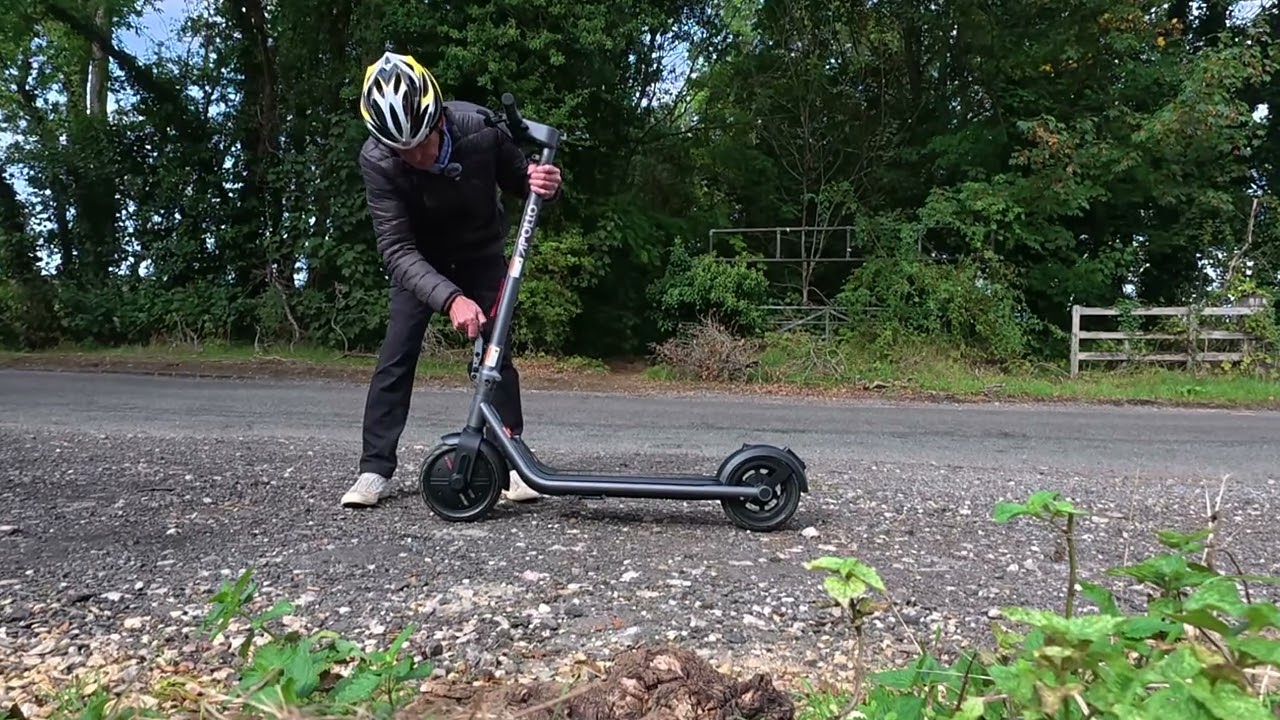
Riding the Apollo Dash has been a much more enjoyable experience than I ever expected. In fact, I haven’t had so much fun on two wheels since my mountain biking days.
I love the feel of the rubbery deck and, while I would still prefer a rear disc brake to a basic drum setup, the adjustable regenerative braking proved a major plus once I hit the road.
I’m also a big fan of the Dash’s cruise control system – particularly on longer stretches – and the ease with which one can flit through its three main riding modes by simply tapping the on/off button.
The lighting system, too, is fantastic and made me feel remarkably visible to other road users. Honestly, I think lighting this effective should be a legal requirement on every e-scooter.
The Dash handled my test runs superbly, and coming from my old trusty Xiaomi with 8.5-inch wheels, I honestly didn’t expect it to feel quite so well planted. Its reassuring geometry, comfortable riding position, lovely ribbed handlebar grips and large 9.5-inch pneumatic tyres worked together brilliantly, giving me a tremendous amount of confidence, even when the asphalt was a bit gnarly. With more practice, I reckon I could really fly along on this thing, speed laws allowing.
However, the biggest surprise of all was when I hit a local hill which is about 200m in length and looks to have an average gradient of around 10% with some steeper sections around 12% to possibly 15%. My Xiaomi Mi Pro 2 scooter would never get more than a few metres up this incline before grinding to a halt, but this thing just kept on going.
My first run was in Mode 3 (15mph), and it held its speed at around 12mph before throttling back to 9mph for the very steepest section. I also tried the same hill in Ludo mode (22mph) but, because I failed to give it full throttle to attack the start of the hill, the results were about the same until I reached the brow and the road flattened out, at which point it quickly gathered pace to reach its full 22mph potential.
However, I did notice that the motor seemed to be gently pulsating during the very steepest section, which I gather is how it was designed. Crucially, at no time did I hear or see any sign of the motor overheating.
In my opinion, this steep incline test was a resounding success because it means that the Dash should easily traverse a wide variety of terrain without ever bogging down. And that’s precisely what you want from an e-scooter. Top marks, I say.
Verdict

The entry-level Apollo Dash is a seriously impressive e-scooter that gets the fundamentals just right. I love the comfortable, grippy rubber-coated deck, planted handling and confidence-inspiring 9.5-inch pneumatic tyres, while the adjustable regenerative braking and excellent cruise control add welcome control and car-like ease of use. No, it’s not the lightest commuter scoot around, but it’s built like a train, and that’s good enough for me.
I’ve also been impressed by the crystal-clear DOT display, the effortless speed mode switching and, when legal, the frankly bonkers Ludo Mode. Add in Apollo’s excellent app, NFC unlocking, Apple Find My tracking and an insanely good lighting system, and you have one of the most thoughtfully designed mid-priced commuter e-scooters on the market.
